

By Tim Morgan, Senior Sommelier & Contributing Editor
There are good pairings, and then there are perfect pairings.
A good pairing is pleasant. The wine doesn’t clash with the food. Nothing goes wrong. You nod, sip, chew, and move on.
A perfect pairing is different. A perfect pairing is a moment of revelation — an instant where the wine transforms the food, the food transforms the wine, and the result is something neither could achieve alone. A third flavour. A new dimension. A small, delicious miracle.
These are twelve of the greatest food-and-wine marriages in the world. Each has been tested by centuries of culture, validated by science, and confirmed by countless sommeliers reaching for the same bottle every time the dish arrives at the table.
They are, in the truest sense, iconic.
1. 🦪 Oysters & Chablis
The dish: Fresh oysters — Gillardeau, Belon, Tsarskaya, Fine de Claire — served raw on ice, with lemon.
The wine: Chablis Premier Cru (Montée de Tonnerre, Fourchaume, Vaillons)
Why it’s perfect: Chablis is made from Chardonnay grown on Kimmeridgian limestone — ancient seabed compressed over millions of years, rich in fossilised oyster shells. The wine literally comes from the same geological material as the food it accompanies. The mineral, flinty, saline character of Chablis mirrors the oyster’s brine with uncanny precision. The acidity cleanses the palate. The wine’s cool, steely character never overwhelms the oyster’s delicacy. It is a pairing of geological poetry.
“A Belon oyster and a glass of Montée de Tonnerre. Sixty million years of geology in a single mouthful.”
2. 🐓 Roast Chicken & White Burgundy
The dish: Whole free-range chicken, roasted with butter, thyme, and garlic. Nothing more.
The wine: Meursault Premier Cru (Charmes, Perrières) or Puligny-Montrachet Village
Why it’s perfect: This is the pairing that sommeliers return to when they want to remind themselves why they fell in love with wine. The golden, butter-basted skin of the chicken meets the golden, barrel-kissed richness of Meursault. The thyme and garlic echo the wine’s herbal and mineral notes. The chicken’s gentle, savoury flavour doesn’t compete with the wine — it provides a stage on which the Burgundy can perform. Simple food, extraordinary wine, and a sum greater than its parts.
“The pairing I would choose for my last meal on earth. Not because it is the most spectacular, but because it is the most true.”
3. 🥩 Bistecca alla Fiorentina & Brunello di Montalcino
The dish: T-bone steak from Chianina cattle, grilled over hot coals, served rare, with nothing but salt, pepper, and olive oil.
The wine: Brunello di Montalcino (Biondi-Santi, Poggio di Sotto, Salvioni)
Why it’s perfect: Tuscany in two acts. The Chianina beef — the oldest breed in Italy, raised on Tuscan pastures — meets Sangiovese in its most noble expression. Brunello’s fierce acidity cuts through the beef’s richness. Its fine tannins bind to the meat’s proteins, softening the wine and concentrating the steak’s flavour. The smoky char of the grill meets the wine’s earthy, leathery complexity. This is not a pairing — it is a cultural statement. It is Tuscany on a plate and in a glass.
“You don’t choose this pairing. It has already been chosen for you — by the land, the breed, the vine, and five centuries of Tuscan tradition.”
4. 🧀 Roquefort & Sauternes
The dish: Roquefort — the king of blue cheeses, made from raw sheep’s milk in the caves of Combalou, crumbly, salty, pungent, electric.
The wine: Sauternes (Château d’Yquem, Suduiraut, Rieussec, Coutet)
Why it’s perfect: The greatest cheese-and-wine pairing in existence. It works on every level: the sweetness of the Sauternes balances the salt of the Roquefort. The wine’s piercing acidity cuts through the cheese’s richness. The honeyed, apricot, botrytis complexity of the wine meets the sharp, tangy, mineral intensity of the cheese, and they neutralise each other’s extremes while amplifying each other’s depths. What remains is a perfectly balanced middle ground of flavour that neither the wine nor the cheese can reach alone. It is the textbook example of contrast creating harmony.
“This is the Everest of food and wine pairing. Everything else is base camp.”
5. 🍝 Tajarin al Tartufo Bianco & Barolo
The dish: Fresh egg pasta — tajarin, the thin Piemontese noodles — with a generous shaving of white truffle (Tuber magnatum), butter, and nothing else.
The wine: Barolo (Giacomo Conterno Cascina Francia, Bartolo Mascarello, Giuseppe Rinaldi)
Why it’s perfect: White truffle is the most intensely aromatic ingredient in gastronomy — earthy, garlicky, musky, ethereal. It needs a wine of equal complexity and intensity, but one that won’t compete with the truffle’s primacy. Barolo is that wine. Nebbiolo’s extraordinary aromatic palette — tar, roses, dried herbs, truffle itself — creates a natural bridge. The wine’s high acidity refreshes the buttery richness of the pasta. Its firm tannins are softened by the egg. And the truffle’s earthy musk finds its soulmate in the wine’s tertiary complexity. This is a pairing of terroir meeting terroir — the hills of Langhe, expressed in both food and wine.
“When the truffle hits the pasta and the aroma rises, reach for the Barolo. The first sip after the first bite is the closest gastronomy comes to transcendence.”
6. 🍷 Foie Gras & Sauternes (or Gewürztraminer VT)
The dish: Pan-seared foie gras — golden, caramelised exterior, silky interior — with a fruit compote (fig, quince, or cherry).
The wine: Sauternes. Or Gewürztraminer Vendange Tardive (Alsace).
Why it’s perfect: Foie gras is one of the richest, most luxurious foods on earth. It needs a wine that can match its intensity without being overwhelmed, while providing enough acidity to cut through the extraordinary richness. Sauternes delivers on every count: the sweetness complements the caramelised surface, the acidity cuts the fat like a blade, and the botrytis complexity adds another dimension of flavour. Gewürztraminer VT works for the same reasons, with the added benefit of exotic lychee and rose petal aromatics that play beautifully with fruit-based accompaniments.
“Foie gras without Sauternes is like a cathedral without light. The structure is there, but the magic is missing.”
7. 🐑 Lamb & Pauillac
The dish: Rack of lamb, herb-crusted (rosemary, garlic, Dijon mustard), roasted pink.
The wine: Pauillac (Lafite, Latour, Lynch-Bages, Grand-Puy-Lacoste)
Why it’s perfect: The “lamb from Pauillac” — agneau de Pauillac — is a local speciality of the Médoc, grazed on the same salt marshes that surround the vineyards. The wine and the meat share the same terroir, the same air, the same mineral-rich soil. Cabernet Sauvignon’s cassis and cedar notes complement the herb crust. The tannins bind to the lamb’s fat. The wine’s structure and the meat’s richness are perfectly calibrated. This is one of the oldest wine-and-food traditions in Bordeaux, and it remains one of the most reliable.
“Pauillac lamb and Pauillac wine. Same soil, same wind, same rain. The pairing is not chosen — it is inherited.”
8. 🐟 Dover Sole Meunière & Meursault
The dish: Whole Dover sole, pan-fried in browned butter with lemon and parsley.
The wine: Meursault Premier Cru (Genevrières, Charmes)
Why it’s perfect: Brown butter is the secret weapon. Its nutty, toasty richness bridges directly to the barrel-fermented, lees-aged character of Meursault. The sole is delicate but substantial — firm-fleshed, sweet, slightly nutty — and it needs a wine with enough body to match without overpowering. Meursault’s combination of richness, acidity, and mineral depth is the perfect counterpart. The lemon in the dish echoes the wine’s citrus acidity. The parsley echoes its herbal undertones. Every element connects.
“The simplest great dish in French cuisine, with the most generous great white wine in Burgundy. A marriage of comfort and elegance.”
9. 🍖 Ibérico Ham & Fino Sherry
The dish: Jamón ibérico de bellota — acorn-fed, 36+ months cured. Sliced paper-thin, room temperature.
The wine: Fino Sherry (Tio Pepe, Inocente, La Barajuela) or Manzanilla (La Gitana, Pastora)
Why it’s perfect: This may be the most viscerally satisfying pairing on this list. The ham is intensely savoury — nutty, salty, umami-rich, with a sweetness from the acorn-fed fat that melts on the tongue. Fino Sherry is dry, saline, razor-sharp, with almond and yeast notes that mirror the ham’s nuttiness. The wine’s acidity and salinity cut through the fat, cleansing the palate and making each slice taste like the first. It is a pairing of such natural, effortless perfection that it feels less like a recipe and more like a law of nature.
“Pour a cold glass of Fino. Lay a slice of ibérico on your tongue. Close your eyes. You are in Andalucía, and the world is very, very good.”
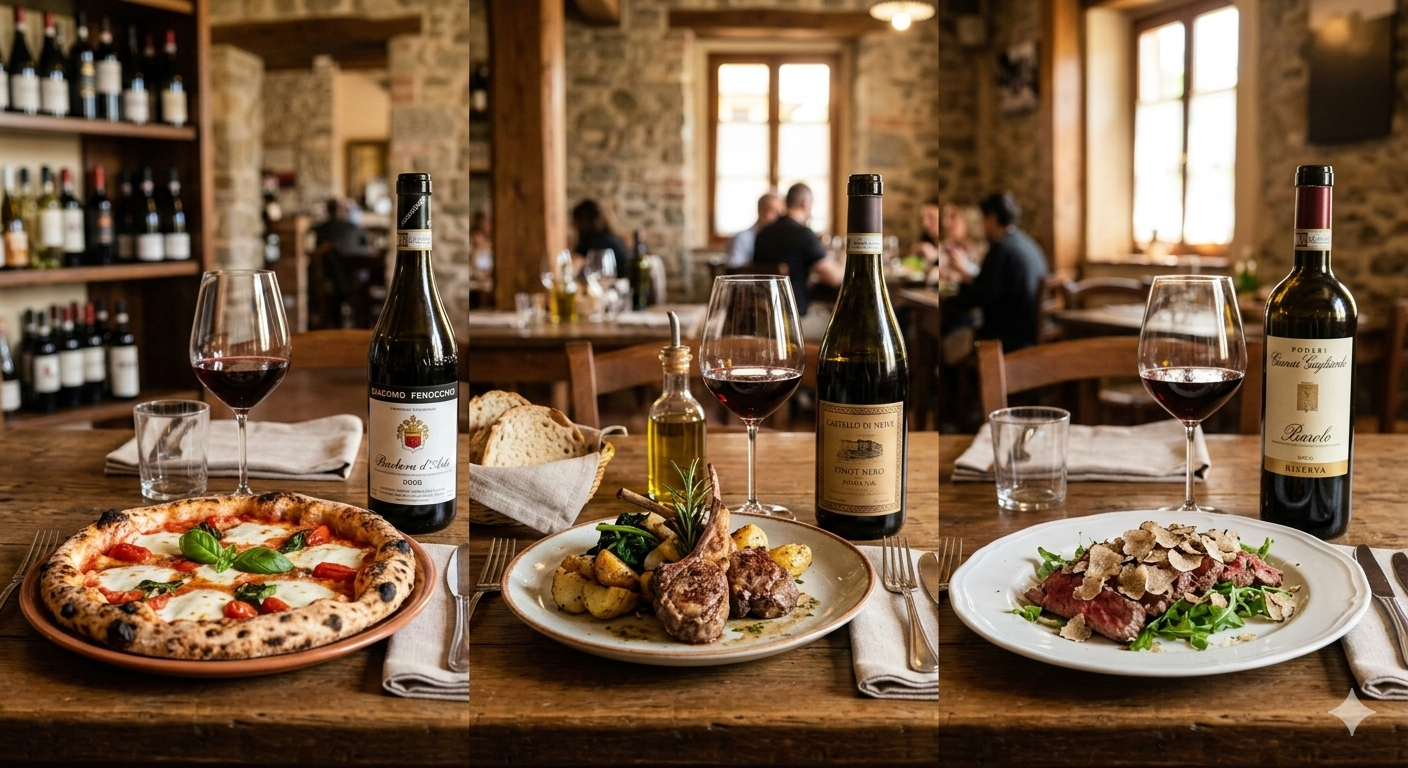
10. 🍕 Pizza Margherita & Barbera d’Alba
The dish: Neapolitan pizza margherita — San Marzano tomatoes, fior di latte, fresh basil, olive oil. Blistered, charred, perfect.
The wine: Barbera d’Alba (Giacomo Conterno, Vietti, Sandrone)
Why it’s perfect: Sometimes the greatest pairings are the simplest. Barbera’s bright, cherry-driven acidity mirrors the acidity of the San Marzano tomatoes. Its lack of heavy tannin means it doesn’t fight the cheese. Its juicy, unpretentious character matches the pizza’s casual, joyful spirit. And its Italian soul — Barbera is Piedmont’s everyday red, the wine of lunch and laughter — is the natural partner for Italy’s most iconic food.
“You don’t need a great wine for pizza. You need the right wine. And the right wine is always Barbera.”