

By Tim Morgan, Senior Sommelier & Contributing Editor
The first time you taste a great Nebbiolo, you will be confused.
You will hold the glass up to the light and see a wine that is barely red — a translucent garnet-ruby that looks more like an aged Pinot Noir or a dark rosé than a serious, structured, cellar-worthy red. You will wonder if there has been a mistake. You will think: this cannot possibly be powerful.
Then you will smell it. And the world will shift.
Dried rose petals. Tar. Wild strawberry. Truffle. Camphor. Violets. Star anise. Leather. Tobacco. The complexity will be staggering — not just one or two notes, but a cascade of aromas that seems to contain entire landscapes, entire seasons, entire lifetimes.
Then you will taste it. And the tannins — my God, the tannins — will grip your palate with a ferocity that seems impossible given the wine’s pale, gentle appearance. Fine-grained, persistent, architectural tannins that coat your mouth and refuse to let go. Behind them, flavours of cherry, raspberry, pomegranate, iron, liquorice, dried herbs. An acidity that could cut glass. A finish that lasts for minutes.
You will set down your glass. You will stare at it. And you will understand, for the first time, why Italians call Nebbiolo the king of grapes — and why Barolo, its greatest expression, is called the king of wines.
Identity Card
| Detail | Info |
|---|---|
| Full name | Nebbiolo |
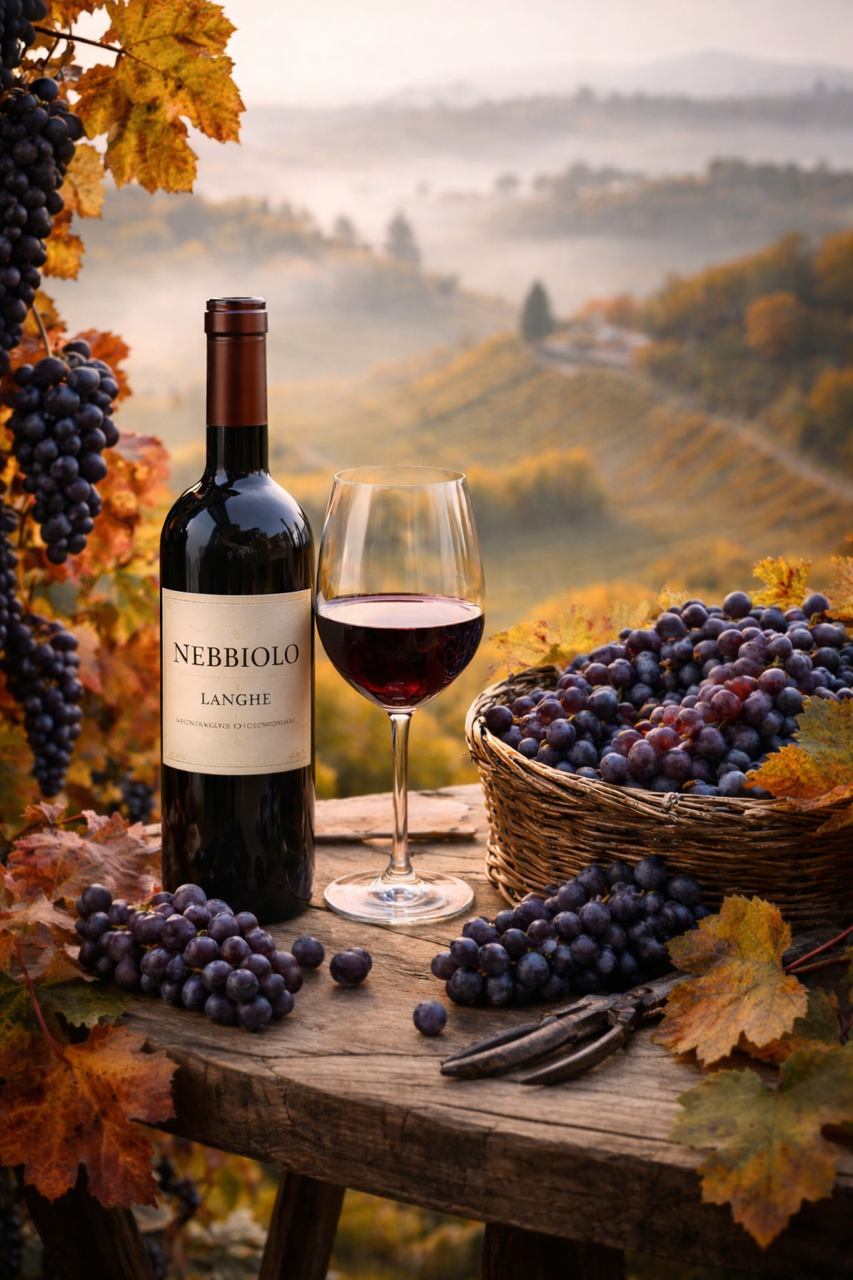
| Name origin | From nebbia — the Italian word for fog. The autumn fogs that blanket the Langhe hills of Piedmont during harvest. |
| Colour | Red — but among the palest of red grapes |
| Origin | Piedmont, Italy — documented since 1268 |
| Skin | Thin, but with very high tannin and pigment compounds (anthocyanins that are unstable, hence the pale colour) |
| Ripening | Very late — one of the last grapes harvested in Piedmont (October–November) |
| Climate | Cool to moderate with significant diurnal temperature variation |
| Acidity | Very high |
| Tannin | Very high |
| Body | Medium to full — but perceived weight far exceeds visual impression |
| Ageing potential | Extraordinary — 20, 30, 50+ years for the finest Barolo and Barbaresco |
| Key character | The paradox grape: pale colour, immense structure. Translucence masking power. |
What Does Nebbiolo Taste Like?
Nebbiolo’s aromatic profile is one of the most distinctive and recognisable in the wine world — once you learn it, you will never mistake it for anything else.
The Signature Notes
THE CLASSIC NEBBIOLO PROFILE:

FRUIT
├── Wild strawberry
├── Sour cherry / morello cherry
├── Raspberry
├── Pomegranate
├── Cranberry
├── Blood orange
└── Dried cherry (with age)

FLORAL
├── Dried rose petals (THE signature note)
├── Violets
├── Potpourri
├── Dried lavender
└── Rose hip

THE "OTHER" NOTES (what makes Nebbiolo unique)
├── Tar (catrame — the most iconic Nebbiolo descriptor)
├── Truffle (especially white truffle)
├── Camphor / menthol / eucalyptus
├── Star anise
├── Liquorice
├── Leather
├── Tobacco
├── Iron / blood
├── Wet earth
├── Dried herbs (sage, thyme, oregano)
├── Balsamic vinegar
└── Sandalwood
“Tar and roses.” That is the classic two-word description of Nebbiolo. It captures the grape’s essential duality: something dark, industrial, almost primordial (tar) paired with something delicate, beautiful, ephemeral (roses). That tension — between power and beauty, between darkness and light — is the essence of Nebbiolo.
The Three Faces of Nebbiolo
Nebbiolo wears three masks, depending on where it grows and how long it ages:
1. Barolo — The King
DOCG since 1980 | Minimum ageing: 38 months (18 in oak). Riserva: 62 months.
Barolo is Nebbiolo’s most powerful, most structured, most age-worthy expression. Grown in five core communes — Barolo, La Morra, Castiglione Falletto, Serralunga d’Alba, and Monforte d’Alba — it produces wines of monumental tannin, extraordinary aromatic complexity, and a longevity that rivals the greatest wines in the world.
The commune differences:
| Commune | Soil | Character |
|---|---|---|
| Serralunga d’Alba | Helvetian (older, more compact) | Powerful, austere, longest-lived. Iron fist. |
| Monforte d’Alba | Helvetian | Structured, deep, muscular. Similar to Serralunga. |
| Castiglione Falletto | Mixed | Balance of power and perfume. The mediator. |
| La Morra | Tortonian (younger, more fertile) | Elegant, perfumed, earlier-drinking. Silk glove. |
| Barolo (village) | Tortonian | Approachable, fragrant, classic. |
Essential Barolo producers:
| Producer | Commune | Style |
|---|---|---|
| Giacomo Conterno | Serralunga | Traditional. Monfortino is the summit. |
| Bartolo Mascarello | Barolo | Traditional. Single-vineyard philosophy. Icon. |
| Bruno Giacosa | Various | Traditional/modern hybrid. Le Rocche del Falletto is legendary. |
| Giuseppe Rinaldi | Barolo | Traditional. Sublime purity. |
| Vietti | Various | Modern-leaning. Excellent across the range. |
| G.D. Vajra | Barolo | Organic. Refined. Outstanding value. |
| Roberto Voerzio | La Morra | Modern. Concentrated, powerful. |
| Elio Altare | La Morra | Modern pioneer. Changed Barolo in the 1980s. |
| Amerio Vincenzo | Piedmont | New generation. Traditional. Exceptional value. Exciting discovery. |
| Luciano Sandrone | Barolo | Modern-traditional balance. Cannubi Boschis is world-class. |
2. Barbaresco — The Queen
DOCG since 1980 | Minimum ageing: 26 months (9 in oak). Riserva: 50 months.
Barbaresco is Nebbiolo’s more approachable — but not lesser — sibling. Grown just northeast of the Barolo zone, in the communes of Barbaresco, Neive, and Treiso, it tends to produce wines that are more perfumed, more elegant, and more immediately seductive than Barolo, while still possessing Nebbiolo’s characteristic tannin structure and ageing potential.
The distinction: If Barolo is the king — stern, powerful, demanding patience — Barbaresco is the queen: equally noble, but with more grace, more charm, more willingness to meet you halfway.
Essential Barbaresco producers:
| Producer | Notes |
|---|---|
| Gaja | The most famous name in Italian wine. Modernist. Exceptional but expensive. |
| Produttori del Barbaresco | Cooperative making single-vineyard Riservas of extraordinary quality at fair prices. The benchmark. |
| Bruno Giacosa | Santo Stefano and Rabajà are legendary. |
| Roagna | Traditional. Old vines. Profound wines. |
| Rizzi | Underrated. Excellent value. |
3. Langhe Nebbiolo / Nebbiolo d’Alba — The Prince
DOC | Minimum ageing: none (or minimal). Younger, more accessible.
Langhe Nebbiolo is Nebbiolo without the weight of expectation. Made from younger vines, declassified fruit, or vineyards outside the Barolo/Barbaresco zones, it offers the Nebbiolo experience — the perfume, the structure, the tannic grip — in a more approachable, earlier-drinking, and significantly more affordable format.
Think of it as baby Barolo — and some of the best, from producers like Amerio Vincenzo, Vajra, or Produttori del Barbaresco, are genuinely stunning.
Beyond Piedmont: Nebbiolo Elsewhere
Nebbiolo is notoriously reluctant to travel. Unlike Cabernet Sauvignon or Chardonnay, which adapt to new environments with relative ease, Nebbiolo is deeply site-specific — it seems to need the particular combination of Piedmontese soil, climate, and altitude to express itself fully.
However, there are notable exceptions:
| Region | Name Used | Character |
|---|---|---|
| Alto Piemonte (Gattinara, Ghemme, Lessona, Boca, Bramaterra) | Spanna | Lighter, more mineral, volcanic/granite soils. Often extraordinary value. The “other” Nebbiolo. |
| Valtellina (Lombardy) | Chiavennasca | Alpine Nebbiolo — lighter, more acid-driven, mineral. Sforzato (dried grape version) is powerful. |
| Valle d’Aosta | Picotendro / Nebbiolo | Mountain Nebbiolo — extreme altitude, lean, mineral. Rare. |
| Australia (Adelaide Hills, King Valley) | Nebbiolo | Emerging. Lighter style. Interesting but not yet rivalling Piedmont. |
| Mexico (Baja California) | Nebbiolo | Surprisingly good. A genuine curiosity. |
| California (Paso Robles, Sierra Foothills) | Nebbiolo | Experimental. Some promising results. |
“Nebbiolo outside Piedmont is like Shakespeare translated into another language. You get the plot, but you lose the poetry.”
Nebbiolo and Food
Nebbiolo’s combination of high acidity, high tannin, and complex savoury character makes it one of the greatest food wines in the world — but it demands dishes of equal stature.
| Dish | Why It Works |
|---|---|
| Tajarin al tartufo bianco | THE pairing. Fresh egg pasta with white truffle. Nebbiolo’s truffle-scented perfume meets actual truffle. Transcendent. |
| Brasato al Barolo | Beef braised in Barolo. The wine in the pot meets the wine in the glass. |
| Agnolotti del plin | Tiny stuffed pasta in broth. Delicate, savoury, perfect with Nebbiolo’s complexity. |
| Risotto al Barolo | Rice cooked in Nebbiolo. The starch softens the tannins. |
| Bollito misto | The great Piedmontese boiled meat platter. Nebbiolo’s acidity cuts the richness. |
| Roasted game | Pheasant, guinea fowl, hare — Nebbiolo’s earthy complexity mirrors game’s wild character. |
| Aged Castelmagno | Blue-veined cheese from Cuneo. Powerful enough to stand with Barolo. |
| Parmigiano Reggiano (48+ months) | Umami meets tannin. The crystals crunch. The wine sings. |
| Vitello tonnato | Cold veal with tuna sauce. Sounds wrong. Tastes right. Trust the Piedmontese. |
| Finanziera | Offal stew — sweetbreads, cockscombs, mushrooms. The ultimate traditional Nebbiolo pairing. |
Sommelier tip: Nebbiolo’s high tannin means it needs food. Drinking Barolo without food is like listening to an opera without the libretto — impressive, but incomplete.
How to Serve Nebbiolo
| Detail | Recommendation |
|---|---|
| Temperature | 16–18°C. Slightly cool. High alcohol + warm room = soupy disaster. |
| Glass | Large, wide-bowled glass — Nebbiolo’s aromatics need space to unfold. |
| Decanting | Essential for young Barolo. 2–4 hours minimum for wines under 10 years old. Older Barolo (20+ years): decant briefly or pour directly — it can fade quickly. |
| Ageing | Langhe Nebbiolo: 3–8 years. Barbaresco: 5–15 years. Barolo: 10–30+ years. Barolo Riserva: 15–50+ years. |
The Nebbiolo Experience
There is a moment — and every Nebbiolo lover knows it — when you open a bottle of aged Barolo, pour it into a wide glass, and wait. Five minutes. Ten. Twenty. And then, slowly, as if waking from a long sleep, the wine begins to open.
The first thing you smell is roses. Then tar. Then something you cannot name — an ancient, earthy, mineral scent that makes you think of autumn in the hills, of fog rolling through vineyards, of things buried deep in the earth.
And then you taste it, and the tannins — still firm, still persistent, after twenty years in the bottle — grip your palate with the authority of a wine that knows exactly what it is and has no interest in being anything else.
This is Nebbiolo. The noble fog. The pale wine with the iron soul. The grape that looks like water and tastes like the earth.
There is nothing else like it.
Tim Morgan is a London-based sommelier and wine writer.