

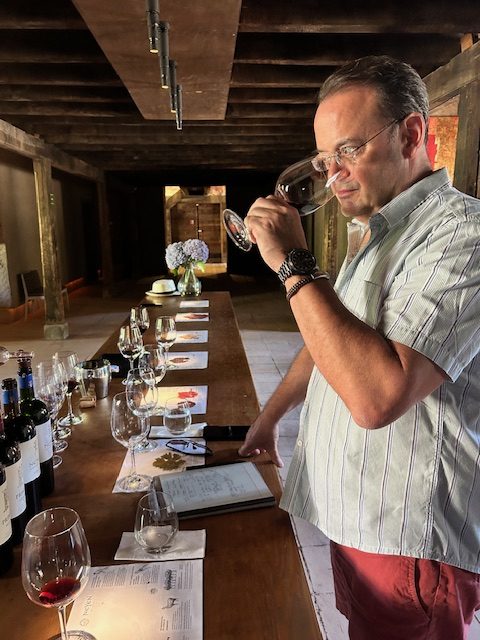
Most people drink wine. Very few taste it. The difference between the two is not talent, not experience, not a gifted palate — it is simply attention. Here is how to pay it, step by step, from a sommelier who has tasted over 10,000 wines.
By Tim Morgan, Sommelier & Contributing Editor
I have a confession to make.
For the first five years that I drank wine, I didn’t taste it. Not really. I lifted the glass. I sipped. I decided — in about two seconds — whether I liked it or not. And then I moved on.
This is how most people experience wine, and there is nothing wrong with it. Wine is a pleasure, not an exam. You are allowed to simply enjoy it.
But somewhere around year five, someone taught me how to taste — how to slow down, how to look, how to smell with purpose, how to let the wine sit on my palate and reveal itself. And everything changed. Wines I had dismissed as “fine” became fascinating. Wines I had thought were “all the same” became wildly, thrillingly different. The world inside the glass — which had been a flat, one-dimensional experience — suddenly opened into three dimensions. Then four. Then more.
What I learned was this: tasting is not a talent. It is a skill. And like every skill — playing piano, speaking a language, cooking an omelette — it can be taught, practised, and improved by anyone.
This guide will teach you. Not how to show off at dinner parties. Not how to pass an exam. But how to pay attention to what is in your glass — so that every bottle you open, from a €5 supermarket wine to a Grand Cru Burgundy, gives you more pleasure, more understanding, and more of the extraordinary, inexhaustible fascination that wine can offer.
Let’s begin.
BEFORE YOU START: SETTING UP
The conditions in which you taste matter more than you think.
Light — Natural daylight or neutral white light. Coloured lighting distorts the wine’s appearance. You need to see the true colour.
Background — A white surface (tablecloth, sheet of paper). Tilt the glass against white to see colour accurately.
Glass — Clean, tulip-shaped, clear, uncoloured, with a stem. The shape concentrates aromas. The stem prevents hand warmth from heating the wine. Coloured glass hides the wine.
Temperature — White wines: 8–12°C. Red wines: 14–18°C. Too cold mutes aromas. Too warm amplifies alcohol and makes wine soupy.
Distractions — Keep them minimal. Strong perfume, cooking smells, scented candles, and aftershave all interfere with your ability to smell the wine.
Palate — Keep it clean and neutral. Don’t taste immediately after coffee, toothpaste, spicy food, or chewing gum. Water and plain bread are your palate’s best friends.
“The most expensive wine in the world will taste ordinary if you drink it from a plastic cup under fluorescent light after eating a curry. Environment matters.”
THE FIVE S’S
Professional wine tasting follows a systematic method. Different schools use different frameworks, but the clearest — the one I teach to beginners and still use myself after 10,000+ wines — is the Five S’s:
SEE — SWIRL — SMELL — SIP — SAVOUR
Each step reveals different information. Together, they build a complete picture of the wine. Let’s take them one at a time.
STEP 1: SEE
What to Do
Hold the glass by the stem. Tilt it at a 45-degree angle against a white background. Look at the wine.
You are looking for three things: colour, clarity, and viscosity.
Colour — White Wines
Pale, almost water-clear — Very young wine. Cool climate. Unoaked. Think Muscadet, Pinot Grigio, Vinho Verde, young Chablis.
Pale gold or straw — Young to moderate age. Possibly some oak contact. Think Sancerre, white Burgundy at village level, Albariño.
Medium gold — Warmer climate or oak ageing. Some age, perhaps 3–5 years. Think oaked Chardonnay, Meursault, Viognier, Condrieu.
Deep gold or amber — Significant age (5–15+ years). Or extended oak ageing. Or skin contact (orange wine). Or oxidative winemaking (Vin Jaune, old Sherry). Or dessert wine (Sauternes, Tokaji). Think aged white Burgundy, orange wine, Fondillón.
Brown — Very old. Or oxidised, which is a fault in most wines. Or intentionally oxidative, as in Sherry, Madeira, or Vin Jaune.
Colour — Red Wines
Pale ruby or garnet, almost transparent — Thin-skinned grape such as Pinot Noir, Nebbiolo, or Gamay. Cool climate. Lighter style. Or significant age (10+ years — reds lose colour over time). Think Burgundy, Barolo, Beaujolais.
Medium ruby — Medium-bodied wine. Moderate climate. Think Rioja, Chianti, Côtes du Rhône, Barbera.
Deep ruby or purple — Thick-skinned grape such as Cabernet Sauvignon, Syrah, Malbec, or Monastrell. Warm climate. Young wine. Concentrated extraction. Think young Bordeaux, Napa Cabernet, Argentine Malbec, Barossa Shiraz.
Brick, tawny, or orange rim — Aged wine, 5–15+ years. The rim of the wine turns from purple to ruby to garnet to brick to brown as it ages. Tilt the glass and look at the edge — the rim colour reveals age. Think mature Bordeaux, aged Barolo, Rioja Gran Reserva.
Brown — Very old. Or oxidised and past its prime. Or intentionally oxidative, as in Tawny Port or old Rioja.
The Rim Test: Tilt the glass 45 degrees against white. Look at the very edge of the liquid — the thinnest point where wine meets glass. In young red wine, the rim is purple or ruby. As wine ages, the rim shifts through garnet, then brick, then amber, then brown. The rim tells you the wine’s approximate age more accurately than the core colour.
Clarity
Crystal clear and brilliant — Filtered wine. Conventional winemaking. Normal.
Slightly hazy — Unfiltered. Common in natural and artisanal wines. Not a fault.
Cloudy or murky — Heavily unfiltered. Or a fault caused by bacteria. Context matters — natural wine may be intentionally cloudy.
Particles or sediment — Aged wine with tartrate crystals or colour pigments settling. Normal and desirable in aged reds. Decant before serving.
Viscosity (Legs or Tears)
Swirl the glass gently and watch the liquid drip down the inside of the glass. These drips are called legs or tears.
Thin, fast-falling legs indicate lower alcohol and lighter body.
Thick, slow, viscous legs indicate higher alcohol and/or higher sugar content.
Important caveat: Legs tell you about alcohol and sugar. They tell you nothing about quality. A €3 wine can have impressive legs. A €3,000 wine can have thin legs. Ignore anyone who judges wine quality by its tears.
STEP 2: SWIRL
What to Do
Hold the glass by the stem or the base and swirl it in small, gentle circles — either on the table or in the air.
Why
Swirling aerates the wine — it increases the surface area of the liquid exposed to air, which volatilises the aromatic compounds and sends them up into the bowl of the glass, where your nose can capture them. In simple terms: swirling makes the wine smell more.
How
If you’re nervous about spilling, keep the base of the glass on the table and make small circles. If you’re confident, lift and swirl in the air. Either way, 3–5 seconds is enough. Don’t swirl violently — you’ll splash. Don’t swirl continuously — you’ll exhaust the aromatics. Swirl, then immediately bring the glass to your nose.
Pro tip: Before you swirl, take one quick smell of the wine in its still, unswirled state. Some aromas — particularly delicate floral notes and faults — are easier to detect before aeration. The first nose (before swirling) and the second nose (after swirling) often reveal different things.
STEP 3: SMELL
This Is the Most Important Step
Here is a truth that surprises most people: the vast majority of what we perceive as “taste” is actually smell. Our tongues can detect only five basic sensations — sweet, sour, salt, bitter, and umami. Everything else — the cherry, the cedar, the rose petals, the truffle, the blackcurrant, the smoke — is detected by your olfactory system (your nose) via a passage at the back of your mouth called the retronasal pathway.
When people say a wine “tastes like cherry” or “tastes like vanilla,” they are almost always describing what they smell, not what they taste. The tongue provides the structure (acid, sweetness, tannin). The nose provides the flavour.
This is why smelling wine carefully is the single most important skill in tasting. If you learn to smell well, you have learned 80% of tasting.
How to Smell
Bring the glass to your nose — not your nose to the glass. Tilt the glass slightly.
Put your nose inside the rim — deep enough that it’s surrounded by the bowl. This is not the time for dainty distance.
Inhale gently through your nose. Short, focused sniffs are more effective than one long deep breath. Your olfactory receptors fatigue quickly — short sniffs reset them.
Pull away and think. What did you smell? Don’t reach for fancy words yet. Just register the impression.
Swirl and smell again. The wine will have opened up. New aromas may have appeared.
Wait five minutes and smell again. Great wines evolve dramatically in the glass. What you smell at minute one may be completely different from minute ten.
What to Smell For: Primary Aromas (The Grape)
These come from the grape variety itself and the growing conditions. They are the fruit, floral, and herbal aromas that are intrinsic to the grape.
White wine primary aromas —
Citrus fruits: lemon, lime, grapefruit, orange, lemon zest.
Stone fruits: peach, apricot, nectarine, white plum.
Tropical fruits: pineapple, mango, passion fruit, lychee, guava.
Green and herbal: green apple, pear, gooseberry, grass, asparagus, fennel, herbs like basil and sage.
Floral: white flowers, jasmine, orange blossom, elderflower, acacia, honeysuckle.
Red wine primary aromas —
Red fruits: cherry, raspberry, strawberry, cranberry, redcurrant, pomegranate, blood orange.
Black fruits: blackcurrant, blackberry, black plum, blueberry, black cherry, damson.
Floral: rose, violet, lavender, peony, iris.
Herbal and spice: black pepper, green pepper or capsicum (a hallmark of Cabernet Sauvignon), mint or eucalyptus, dried herbs (thyme, oregano, rosemary), bay leaf, liquorice, olive.
Shortcut: Red fruits (cherry, raspberry, strawberry) generally indicate cooler climate or lighter grape. Black fruits (blackcurrant, blackberry, plum) generally indicate warmer climate or fuller grape. This is a generalisation, but it holds true remarkably often.
What to Smell For: Secondary Aromas (Winemaking)
These are created during fermentation and cellar work — the winemaker’s influence on the wine.
From oak ageing: vanilla, toast, cedar, coconut, smoke, coffee or espresso, chocolate, caramel, clove, nutmeg, cinnamon, dill (American oak specifically).
From malolactic fermentation: butter, cream, butterscotch, yoghurt.
From lees ageing (contact with dead yeast cells): brioche, bread dough, biscuit, pastry, yeast, fresh bread.
From fermentation itself: banana and bubblegum (carbonic maceration, as in Beaujolais), pear drops, nail polish (if excessive, this may indicate a fault — volatile acidity).
What to Smell For: Tertiary Aromas (Ageing)
These develop during extended ageing in bottle, or in barrel or solera for extended periods. They are the aromas of time.
Oxidative and evolved notes: dried fruit (fig, date, prune, dried apricot), nuts (walnut, hazelnut, almond), caramel, toffee, butterscotch, honey, beeswax, marmalade, petrol or kerosene (aged Riesling specifically), rancio (aged fortified wines — nutty, oxidative), sherry-like character.
Earthy and savoury notes from bottle ageing in reds: leather, tobacco, cigar box, truffle, mushroom, forest floor, wet earth or petrichor, game or meat, dried herbs, iron or blood, tar (Nebbiolo specifically), autumn leaves.
The key insight: Young wines show mostly primary aromas — fruit and floral. As wines age, the primary aromas fade and tertiary aromas — earth, leather, mushroom, dried fruit — develop. The most complex wines show all three categories simultaneously — fruit, winemaking influence, and age — in perfect balance. This is what wine professionals mean when they call a wine “complex.”
Common Faults — What Shouldn’t Be There
Wet cardboard, damp basement, mouldy newspaper — This is cork taint (TCA). A contaminated cork has ruined the wine. This is the most common fault, affecting roughly 3–5% of cork-sealed bottles. The wine is ruined — send it back.
Rotten eggs, struck match, cabbage — This is reduction, caused by lack of oxygen during winemaking. It often dissipates with swirling or decanting. If it persists, it’s a fault.
Nail polish remover, vinegar — This is volatile acidity (VA). At low levels, it can add lift. At high levels, the wine smells like a nail salon. A fault.
Barnyard, Band-Aid, sweaty saddle — This is Brettanomyces, a spoilage yeast. At very low levels, some producers and drinkers find it adds complexity. At high levels, it is an unquestionable fault.
Sherry-like, flat, stale (in a wine that shouldn’t be) — This is premature oxidation from oxygen exposure. A fault in most wines, but intentional in Sherry, Vin Jaune, and similar oxidative styles.
Mousey, stale aftertaste — This is mouse taint, a bacterial contamination increasingly discussed in natural wine circles. It is difficult to detect on the nose — it appears on the palate after swallowing. A fault.
The cork taint rule: If you suspect a wine is corked, the simplest test is to pour a tiny amount into a glass, cover it with your hand, swirl, and sniff. Cork taint becomes more obvious in a concentrated environment. If you smell wet cardboard — even faintly — the wine is corked. Don’t talk yourself out of it. Trust your nose.
STEP 4: SIP
What to Do
Take a moderate sip — enough to coat your entire mouth, but not so much that you can’t move it around comfortably. This is not drinking. This is analysing.
Now — and this is the part that feels strange at first — move the wine around your mouth. Let it touch every surface: the tip of your tongue, the sides, the back, the gums, the roof of your mouth. Different parts of your mouth are sensitive to different sensations.
Some professionals draw a small amount of air through the wine while it’s in their mouth (the slurping or aerating technique). This sends aromatic compounds up the retronasal passage to the olfactory bulb, dramatically intensifying the flavour perception. It looks — and sounds — ridiculous. But it works.
4A. Sweetness
Detected on the tip of the tongue in the first 1–2 seconds.
Bone dry — No perceptible sweetness. Examples: Chablis, Muscadet, Sancerre, dry Riesling Trocken.
Dry — Very minimal sweetness. Examples: most red wines, most white wines, Champagne Brut.
Off-dry — Just a hint of sweetness. Examples: Riesling Kabinett, Vouvray demi-sec, Gewürztraminer.
Medium-sweet — Clearly sweet but balanced by acidity. Examples: Riesling Spätlese, Moscato d’Asti.
Sweet — Substantially sweet. Examples: Sauternes, Tokaji Aszú, late harvest wines.
Lusciously sweet — Intensely, decadently sweet. Examples: TBA, Eiswein, PX Sherry, Fondillón.
Critical point: Sweetness and fruitiness are NOT the same thing. A wine can taste very fruity — ripe berry, tropical fruit — while being completely dry, meaning it has no residual sugar. Fruit flavour comes from the grape’s aromatic compounds. Sweetness comes from actual sugar remaining in the wine after fermentation. Don’t confuse them.
4B. Acidity
Detected on the sides of the tongue and in the cheeks. The sensation is mouth-watering — literally. Your mouth produces saliva in response to acid.
Low — Flat, flabby, lacking freshness. The mouth feels sluggish, the wine feels heavy. Examples: some warm-climate whites, overripe reds.
Medium — Balanced, pleasant freshness. Comfortable, easy-drinking. Examples: most well-made wines at the mid-range.
High — Bright, zesty, electric. The mouth waters intensely, the tongue tingles. Examples: Chablis, Riesling, Barbera, Champagne, Sancerre.
Very high — Searing, sharp, almost painful. Cheeks pucker, jaw tightens. Examples: green or unripe wine, or intentionally high-acid styles like Vinho Verde.
The saliva test: After swallowing or spitting, notice how much your mouth waters. The more saliva your mouth produces, the higher the wine’s acidity. This is the most reliable physical indicator.
Why acidity matters: Acidity is the skeleton of wine. Without it, even the most flavorful wine tastes flat, flabby, and dull. With too much, wine tastes sharp, aggressive, and unripe. In balance, acidity gives wine freshness, lift, energy, and — critically — the ability to age. Wines with high natural acidity (Riesling, Nebbiolo, Champagne) age far longer than wines with low acidity.
4C. Tannin (Red Wines Only)
Detected as a drying, gripping, textural sensation across the gums, tongue, and inside of the cheeks. Tannin is not a taste — it is a tactile sensation, like touching a rough surface with your tongue.
Low — Soft, smooth, barely perceptible. Silky, easy, no grip. Examples: Pinot Noir, Gamay, Frappato, Dolcetto.
Medium — Noticeable but balanced. Gentle grip, pleasant texture. Examples: Sangiovese, Tempranillo, Merlot, Grenache.
High — Firm, structured, mouth-coating. Dry, chalky, gripping. Examples: Cabernet Sauvignon, Nebbiolo, Tannat, young Barolo.
Very high — Astringent, almost aggressive. Mouth feels like sandpaper, cheeks pucker aggressively. Examples: very young Barolo, Sagrantino, Mourvèdre, some Madiran.
Tannin quality matters as much as tannin level. Fine-grained tannin feels silky, powdery, and elegant — think Pinot Noir or aged Barolo. Coarse or grainy tannin feels rough, drying, and aggressive — often a sign of over-extraction or unripe grapes. Ripe tannin feels sweet, round, and supple. Green or unripe tannin feels bitter, harsh, and vegetal.
4D. Body
Body is the overall weight and density of the wine on your palate — the sense of fullness or lightness. Think of it as the difference between skimmed milk, whole milk, and cream.
Light — Delicate, ethereal, weightless. Like water or skimmed milk. Examples: Muscadet, Vinho Verde, Mosel Riesling Kabinett, Beaujolais.
Medium-light — Slightly more substance. Like semi-skimmed milk. Examples: Sancerre, Chablis, village-level Burgundy Pinot Noir.
Medium — Balanced weight. Like whole milk. Examples: most white Burgundy, Chianti, Rioja Crianza, Côtes du Rhône.
Medium-full — Substantial. Like single cream. Examples: Meursault, Barbaresco, Ribera del Duero, Châteauneuf-du-Pape.
Full — Dense, rich, concentrated. Like double cream. Examples: Barolo, Napa Cabernet, Barossa Shiraz, Amarone, Sauternes.
What creates body: Primarily alcohol, sugar, and extract (tannin, glycerol, dry extract from the grape). Higher alcohol equals fuller body. More residual sugar equals fuller body. More tannin equals greater textural presence.
4E. Alcohol
Detected as a warming, burning sensation at the back of the throat and on the palate.
Low (below 10%) — Light, delicate, easy. Examples: Moscato d’Asti at 5.5%, German Riesling Kabinett at 7.5–9%.
Medium-low (10–11.5%) — Fresh, energetic. Examples: Champagne, Vinho Verde, many German wines.
Medium (11.5–13.5%) — Balanced, moderate warmth. Examples: most white wines, lighter reds.
Medium-high (13.5–14.5%) — Noticeable warmth. Examples: most New World reds, oaked Chardonnay, Barolo.
High (14.5% and above) — Hot, burning. Examples: Amarone, Zinfandel, some Napa Cabernet, Châteauneuf-du-Pape.
Fortified (15–22%) — Intense warmth. Examples: Port, Sherry, Madeira, Fondillón (which reaches this level naturally, without fortification).
When alcohol is in balance, you barely notice it — it contributes warmth and body without burning or dominating. When alcohol is out of balance (too high for the wine’s fruit and acidity), the wine feels “hot” — a burning sensation at the back of the throat that is unpleasant and distracting.
STEP 5: SAVOUR (The Finish)
What to Do
After swallowing (or spitting, if tasting professionally), pay attention to what happens next. The finish — also called the aftertaste or length — is one of the most important indicators of wine quality.
Length
Short (less than 3 seconds) — Simple, basic wine.
Medium (3–6 seconds) — Good, well-made wine.
Long (6–12 seconds) — Very good to excellent wine.
Very long (12–30+ seconds) — Exceptional wine.
Endless (30 seconds to minutes) — World-class. The hallmark of true greatness.
The caudalie: In professional tasting, finish length is sometimes measured in caudalies, where one caudalie equals one second of flavour persistence. A wine with a finish of 15 caudalies is considered excellent. Anything above 20 is exceptional. The greatest wines — Monfortino, Le Montrachet, Nacional — can reach 30 caudalies or more.
Character of the Finish
Clean, pure, and fresh — Well-made wine. Good acidity. No faults.
Bitter — Can be a positive (Italian reds — Nebbiolo’s bitter almond) or a negative (over-extracted tannin, unripe grapes). Context matters.
Warm or hot — High alcohol. If burning, the wine is out of balance.
Mineral — Chalk, stone, flint, salt — often a sign of terroir expression. Associated with the finest wines.
Fruity — Primary fruit persists. Usually indicates a young, vibrant wine.
Savoury or earthy — Leather, tobacco, mushroom. Indicates age, complexity, or a wine-with-food style.
Sweet — Residual sugar or ripe fruit character. Expected in dessert wines. Unexpected in a dry wine, it may indicate over-ripeness.
Astringent or drying — Tannin lingers. Normal in young tannic reds (Barolo, young Bordeaux). Will soften with age.
The Final Question: Balance
After all five steps, ask yourself the single most important question in wine tasting:
Is the wine in balance?
Balance means that no single element dominates — that the acidity, sweetness, tannin, alcohol, fruit, and oak are all integrated into a harmonious whole. A balanced wine may be light or full, dry or sweet, young or old — but every component serves the whole. Nothing sticks out. Nothing is missing.
A balanced wine: Acidity, fruit, tannin, alcohol, and oak all work in harmony.
An unbalanced wine: Too much acidity makes it taste sharp, sour, and aggressive. Too much tannin makes it taste bitter, astringent, and drying. Too much alcohol makes it taste hot, burning, and heavy. Too much oak makes it taste like vanilla extract or sawdust. Too much fruit makes it taste jammy, one-dimensional, and cloying. Too little acidity makes it taste flat, flabby, and dull.
“Balance is not perfection. A wine can be young and tannic — technically ‘unbalanced’ — and still be magnificent, because you can sense that the tannin will soften, the fruit will integrate, and the wine will find its equilibrium in time. The question is not ‘is this wine balanced right now?’ The question is ‘will this wine find balance?’ Great wine always does.”
PUTTING IT ALL TOGETHER: A Sample Tasting Note
Let’s apply the Five S’s to a hypothetical wine — a 2019 Barolo from Piedmont.
SEE — “Pale to medium garnet with a distinctly translucent quality. Slight brick-orange tint at the rim, despite relative youth. Classic Nebbiolo pallor — deceptively light in colour.”
SWIRL — Wine clings to the glass with moderate viscosity. Legs suggest medium-high alcohol.
SMELL — “The nose opens slowly — initially restrained, almost shy. After ten minutes: dried rose petals, wild cherry, tar, a hint of camphor. With further air, truffle, leather, dried sage, star anise, blood orange, and a vein of iron minerality emerge. Extraordinary complexity for a young wine. Primarily primary and early tertiary aromas — very little overt oak influence.”
SIP — Bone dry. Acidity is very high — razor-sharp, electric, mouth-watering. Tannin is high — fine-grained, chalky, persistent, coating. Firm but not aggressive. Ripe. Body is medium to medium-full. Alcohol is medium-high at 14.5%, well-integrated, no burn. Flavour intensity is high — concentrated but not heavy. Flavours on palate: sour cherry, pomegranate, liquorice, dried herbs, bitter almond, tar, iron.
SAVOUR — “The finish is exceptional — easily 20+ seconds. Waves of rose, tar, bitter cherry, and fine tannin that ebb slowly. A persistent mineral, iron-like note anchors everything. The finish leaves a lasting impression of structure, depth, and restrained power.”
ASSESSMENT — “Outstanding quality. Classic Barolo profile with remarkable aromatic complexity for its age. Firmly structured — built for long ageing (15–25+ years) but already showing beautiful perfume. High acidity and fine tannin suggest an elegant, traditional style. Needs 2–4 hours of decanting if drinking now, or ideally 5–10 years of cellaring.”
Score: 94/100
THE VOCABULARY: Building Your Tasting Language
One of the biggest barriers to wine tasting is finding the words. You smell something in the glass, but you can’t name it. The flavour is on the tip of your tongue — literally — but the vocabulary isn’t there.
This is normal. Wine vocabulary is learned, not innate. Here are the most important descriptors to have in your toolkit.
Essential White Wine Descriptors
Light and cool climate: Green apple, lemon, lime, grapefruit, pear, gooseberry, mineral, chalk, flint, wet stone, herbs, grass, white flowers.
Moderate and classic: Peach, apricot, nectarine, melon, honeysuckle, jasmine, hazelnut, almond, brioche, toast.
Rich and warm climate: Pineapple, mango, passion fruit, banana, butter, vanilla, caramel, honey, tropical, oily, waxy.
Aged: Petrol, honey, toast, marmalade, mushroom, lanolin, dried apricot, smoke, ginger.
Essential Red Wine Descriptors
Light reds: Cherry, raspberry, strawberry, cranberry, rose, violet, fresh herbs, pepper, earth, mushroom.
Medium reds: Plum, dark cherry, beginning of blackberry, leather, tobacco, dried herbs, spice, cedar, vanilla.
Full reds: Blackcurrant (cassis), blackberry, black plum, chocolate, coffee, smoke, tar, liquorice, graphite, iron, game, meat.
Aged reds: Dried fruit, leather, tobacco, truffle, forest floor, wet earth, mushroom, cedar, cigar box, dried herbs, autumn leaves, iron.
The Flavour Trigger Exercise
If you struggle to identify aromas in wine, try this exercise at home. Go to a market or grocery store. Buy the following items. Smell each one carefully, with your eyes closed, and memorise the scent.
Fruit — Fresh raspberries. Blackcurrants (or Ribena). Cherries, both fresh and dried. Green apple. Lemon, both zest and juice. Grapefruit. Peach. Apricot. Passion fruit. Dried fig.
Floral — Fresh roses (buy one stem). Violet (violet candy if fresh is unavailable). Jasmine tea. Elderflower cordial. Orange blossom water.
Savoury — Black pepper (freshly cracked). Cloves. Cinnamon sticks. Vanilla pod (split open). Cedar pencil (sharpen one — smell the shavings). Tobacco (visit a tobacconist). Leather (smell a leather bag or belt). Fresh truffle (if you can find and afford one). Dried thyme, oregano, sage.
Earth and mineral — Wet stone (pour water on a clean stone). Fresh mushrooms (smell raw). Forest floor (go outside — smell the earth under trees). Chalk (break a piece and smell it). Flint (strike two stones together — smell the spark).
Oak and winemaking — Vanilla extract. Toast (fresh from the toaster). Butter (warm it gently). Coffee beans (freshly ground). Dark chocolate (70%+). Coconut. Caramel.
Smell each one three times. Close your eyes. Memorise. The next time you smell cherry in a glass of wine, your brain will have a reference point. The vocabulary will come naturally, because the memory will be there.
“Wine tasting is not about having a gifted nose. It is about having a trained one. Every sommelier in the world built their aroma library the same way — by smelling everything, constantly, obsessively, until the language became automatic.”
THE PRACTICE PLAN: From Beginner to Confident Taster
Week 1–4: Foundation
Taste two wines side by side every week. Same grape, different region — or same region, different grape.
Week 1: Chablis versus oaked Chardonnay (Meursault or California).
Week 2: Pinot Noir (Burgundy) versus Cabernet Sauvignon (Bordeaux).
Week 3: Sauvignon Blanc (Sancerre) versus Sauvignon Blanc (Marlborough).
Week 4: Riesling (dry, Germany) versus Riesling (off-dry, Germany).
Use the Five S’s. Write notes. Compare. Don’t worry about being “right.” Focus on noticing differences.
Week 5–8: Building Range
Taste three wines side by side. One exercise per week. Themed flights.
Week 5: Light red versus medium red versus full red. For example: Beaujolais Cru, then Chianti Classico, then Napa Cabernet.
Week 6: Three white grapes. For example: Riesling, then Sauvignon Blanc, then Chardonnay.
Week 7: One grape, three countries. For example: Pinot Noir from Burgundy, then Oregon, then New Zealand.
Week 8: Old World versus New World. For example: Bordeaux versus Napa Cabernet, or Burgundy versus Oregon Pinot.
Week 9–12: Refinement
Blind tasting. Have a friend pour wine into your glass without showing the bottle. Use the Five S’s. Try to identify:
Is it white or red? (Obvious — but get the habit of systematic assessment.)
Is it light, medium, or full-bodied?
Is the acidity low, medium, or high?
Is there oak influence?
What grape might it be?
What region might it be?
Don’t worry about getting it wrong. Blind tasting is hard. The goal is not accuracy — it is discipline. The Five S’s become second nature through blind tasting.
Ongoing: The Lifetime Practice
Every time you taste wine — at a restaurant, at home, at a friend’s house — pause before you sip. Look at the colour. Smell before you drink. Think about what you’re tasting. Write a note, even one sentence on your phone.
This is the practice that separates people who drink wine from people who taste it. It takes 30 seconds. It changes everything.
THE SCORING QUESTION: Points, Stars, or Nothing?
You will encounter wine scored in various systems.
The 100-point scale is used by Wine Spectator, Wine Advocate (Robert Parker), Wine Enthusiast, Vinous, and this publication. The range is 50–100, though effectively 80–100, since almost nothing scores below 80.
The 20-point scale is used by Jancis Robinson, academic institutions, and WSET. The range is 0–20, effectively 12–20.
The 5-star scale is used by various guides and magazines.
Some critics prefer no score at all, using descriptive words only.
What the 100-Point Scale Actually Means
95–100: Exceptional or legendary. Among the finest wines in the world. Profound complexity, perfect balance, extraordinary length. Life-changing.
90–94: Outstanding or excellent. A wine of real distinction. Complex, well-crafted, memorable. Worth seeking out.
85–89: Very good. Well-made, enjoyable, shows character. Represents good value at its price point.
80–84: Good. Competent, pleasant, correct. Nothing wrong, nothing exceptional.
Below 80: Below average to poor. Flawed, unbalanced, or simply dull. Life is too short.
My honest opinion on scores: Numbers are useful as shorthand — a quick way to communicate quality in a crowded market. But they are inherently reductive. A wine that scores 93 is not objectively “better” than a wine that scores 91. Scores reflect one person’s palate, on one day, in one context. Use them as a guide, not a gospel. The only score that truly matters is the one your own palate gives.
COMMON MYTHS — DEBUNKED
“I don’t have a good palate.” — Almost everyone can taste. Your nose has 400 types of olfactory receptors. The difference between a beginner and a professional is training, not biology.
“You need to taste hundreds of wines to get good.” — You need to taste carefully. Ten wines tasted with full attention teach you more than a hundred wines gulped mindlessly.
“Wine legs indicate quality.” — Legs indicate alcohol and/or sugar content. Nothing else. They are irrelevant to quality.
“Red wine should be served at room temperature.” — This advice dates from a time when “room temperature” was 16°C in an unheated European château. Modern room temperature (21–23°C) is far too warm for red wine. Chill it slightly — 15–18°C.
“Screw caps mean cheap wine.” — Screw caps are used by some of the world’s finest producers — most of Australia and New Zealand, increasingly in Europe. They eliminate cork taint entirely. Many professionals prefer them.
“Old wine is better than young wine.” — Most wine is made to be drunk young, within 1–5 years. Only a tiny percentage improves with age. An old wine that wasn’t built to age is just an old bad wine.
“Wine tasting is subjective — there’s no right or wrong.” — Preferences are subjective. Quality assessment is mostly objective. A professional can identify that a wine is well-made even if they don’t personally enjoy the style.
“You have to spit to be a professional taster.” — You don’t have to. But if you’re tasting 30+ wines, you should — unless you want your notes from wine number 25 to read like drunk poetry.
THE LAST WORD: WHY BOTHER?
You might reasonably ask: why go through all this trouble? Why not just drink the wine and enjoy it?
You can. And you should. Wine is, above all, a pleasure. Not an exam. Not a performance. Not a competition.
But I will tell you this: learning to taste — really taste, with attention and care and the simple discipline of the Five S’s — does not make wine more serious. It makes wine more pleasurable. It multiplies the joy. It turns a single sip into a conversation with a place, a person, a season, a tradition. It transforms a glass of wine from background noise into foreground music.
You don’t need to be a sommelier. You don’t need to memorise appellations or vintages or producer names. You just need to do one thing:
Slow down.
Look at what’s in your glass. Smell it before you taste it. Let it sit on your palate for a moment. Think — even briefly — about what it’s telling you.
That’s it. That is the entirety of wine tasting. Everything else is refinement.
The wine is already extraordinary. All you have to do is pay attention.
Tim Morgan is a sommelier and wine writer based in London. He has tasted over 10,000 wines and still gets excited by every glass. He holds the WSET Diploma.
Related Articles: