

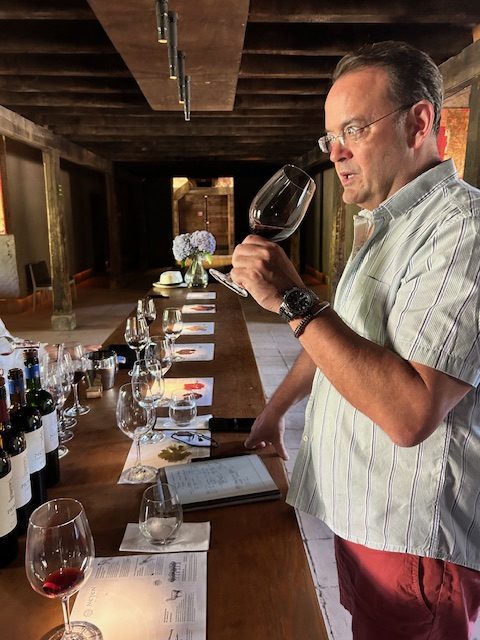
By Tim Morgan, Senior Sommelier & Contributing Editor
Ask ten wine professionals to define natural wine and you will get twelve answers. At least three of them will be angry.
No topic in the modern wine world generates more passion, more confusion, more tribal loyalty, and more eye-rolling contempt than natural wine. It has been called a revolution, a regression, a philosophy, a marketing scam, a flavour category, a lifestyle, a religion, and — by one particularly exasperated Bordeaux négociant — “an organised assault on common sense.”
It is none of those things. And it is, in some ways, all of them.
What natural wine actually is — what it means, how it is made, why it matters, and where it falls short — deserves a clearer, calmer, more honest conversation than it usually receives. This is an attempt at that conversation.
The Problem of Definition
The single biggest issue with natural wine is that there is no legal definition.
Unlike “organic wine” (legally defined in both the EU and the US) or “biodynamic wine” (certified by Demeter or Biodyvin), “natural wine” has no official certification, no governing body, and no universally agreed-upon set of rules.
This means that the term is used to describe everything from masterfully crafted, terroir-driven wines of extraordinary purity to badly made, flawed, undrinkable liquids that hide their faults behind a philosophical label.
However, a working consensus has emerged among practitioners and serious commentators. Here is the closest thing to a definition:
Natural wine is wine made from organically or biodynamically farmed grapes, fermented with indigenous (wild) yeasts, with little or no added sulphur, and with no (or minimal) other additions or interventions in the cellar.
In practice, this means:
| Natural Wine IS | Natural Wine IS NOT |
|---|---|
| Organic or biodynamic farming (always) | Conventional farming with pesticides/herbicides |
| Wild/indigenous yeast fermentation | Commercial cultured yeast |
| No (or very low) added sulphites | Heavily sulphured |
| No added sugar, acid, tannin, enzymes, fining agents | Adjusted, corrected, “improved” in the cellar |
| Unfiltered or lightly filtered | Sterile-filtered |
| Minimal or zero new oak | Heavily oaked for flavour |
| Hands-off winemaking | Micromanaged, technology-driven winemaking |
The Philosophy
Natural wine is, at its core, a reaction against industrial winemaking — the idea that wine should be manufactured like a consumer product, with consistency, predictability, and brand uniformity as the primary goals.
In conventional winemaking, a vast toolkit of interventions is available:
textWHAT CONVENTIONAL WINE CAN ADD:
- Commercial yeast (selected for specific flavour profiles)
- Sugar (chaptalisation — to increase alcohol)
- Acid (tartaric acid — to increase freshness)
- Tannin powder (to add structure)
- Oak chips or staves (cheaper than barrels)
- Enzymes (to clarify, stabilise, extract colour)
- Fining agents (egg white, casein, isinglass, bentonite)
- Mega Purple (concentrated grape colour — yes, really)
- Sulphur dioxide (preservative — in large quantities)
- Water (to reduce alcohol — legal in some jurisdictions)
- Reverse osmosis, spinning cone, cryoextraction...
Natural wine’s position is simple: none of that. Let the grape be the grape. Let the place be the place. Let the vintage be the vintage. If the wine is different every year, good — it should be. Wine is an agricultural product, not a soft drink.
The Good
At its best, natural wine delivers something that no other category can match: purity of expression.
A great natural wine — made by a skilled winemaker from excellent fruit in a good vintage — has a vibrancy, a liveliness, a sense of energy that is immediately recognisable. The flavours are vivid. The textures are alive. There is a transparency — a sense of tasting the grape and the place without any intermediary — that can be genuinely thrilling.
The best natural wines are not “alternative” wines. They are simply great wines that happen to be made with minimal intervention:
| Producer | Region | Why They’re Exceptional |
|---|---|---|
| Pierre Overnoy | Jura, France | Savagnin and Poulsard of heartbreaking beauty. The godfather. |
| Marcel Lapierre (legacy) | Beaujolais, France | Proved that natural Gamay could be world-class. |
| Arianna Occhipinti | Sicily, Italy | Nero d’Avola and Frappato of purity and grace. |
| Jean-François Ganevat | Jura, France | Impossibly complex whites and reds. Genius. |
| Domaine de la Romanée-Conti | Burgundy, France | Yes — DRC. Organic farming, wild yeast, minimal sulphur. Natural by every measure. |
| Raúl Pérez | Bierzo, Spain | Mencía of extraordinary depth and terroir transparency. |
| Valentini | Abruzzo, Italy | Trebbiano d’Abruzzo aged for years. Legendary. Natural before natural was a word. |
| Nicolas Joly | Loire, France | Biodynamic pioneer. Savennières of profound complexity. |
The Bad
At its worst, natural wine is terrible.
Let’s be honest, because the natural wine community’s reluctance to admit this is one of its greatest weaknesses: some natural wines are faulty. They smell of barnyard, band-aid, nail polish, mouse, or vinegar — not because these are “interesting expressions of terroir” but because the winemaking went wrong.
The most common faults:
| Fault | Cause | Smell/Taste |
|---|---|---|
| Volatile acidity (VA) | Acetic acid bacteria (vinegar) | Nail polish, vinegar |
| Brettanomyces | Spoilage yeast | Barnyard, sweaty saddle, band-aid |
| Mouse taint | Bacterial contamination | Mousey, stale, unpleasant aftertaste (appears after swallowing) |
| Oxidation (premature) | Insufficient protection from air | Flat, brown, stale, sherried (when not intended) |
| Reduction | Lack of oxygen | Rotten eggs, struck match (usually dissipates with air) |
These faults exist in conventional wine too — but the safety net of sulphur, filtration, and cellar interventions catches most of them before bottling. In natural wine, without that safety net, the risk is higher.
The uncomfortable truth: A significant percentage of natural wines on the market today are flawed. Not interestingly different. Not challengingly unconventional. Just flawed. And the culture around natural wine — which sometimes treats any criticism as reactionary conservatism — makes it difficult to say so without being accused of not “getting it.”
“A faulty wine is a faulty wine, regardless of the philosophy behind it. Calling a mousey wine ‘natural’ does not make it good. It makes it a mousey natural wine.”
The Middle Ground
The most interesting development in the natural wine conversation is the emergence of a middle ground — producers who embrace natural wine’s core principles (organic farming, wild yeast, minimal intervention) while maintaining enough technical skill and discipline to avoid faults.
These producers might use a tiny amount of sulphur at bottling. They might filter lightly if a wine is unstable. They might intervene when a fermentation is going wrong. They are not ideological purists. They are pragmatists — people who believe in natural winemaking as a philosophy but refuse to sacrifice quality on the altar of dogma.
This middle ground has a name that is gaining traction: low-intervention wine. It lacks the romantic appeal of “natural” — it sounds like a medical procedure — but it is arguably more honest. It says: we intervene as little as possible, but we are not afraid to act when the wine needs it.
Many of the world’s greatest winemakers occupy this space without ever using the term “natural”:
- Domaine Leroy (Burgundy) — biodynamic, wild yeast, minimal sulphur
- López de Heredia (Rioja) — unchanged methods for 140 years
- Gravner (Friuli) — natural in every sense, but would never use the label
- Ridge Vineyards (California) — transparency, minimal intervention, wild yeast since the 1960s
Where I Stand
I believe in the principles of natural wine. I believe that organic farming is better for the land. I believe that wild yeast fermentation creates more complex, more site-specific wines. I believe that minimal intervention in the cellar preserves the identity of the grape and the vintage. I believe that the natural wine movement has been one of the most positive forces in the wine industry in the last thirty years.
But I also believe this: the wine must be good.
Philosophy without quality is propaganda. A faulty wine served with conviction is still a faulty wine. The best natural winemakers know this — they are obsessive about quality, meticulous in the vineyard, and skilled enough in the cellar to make great wine without a safety net. They do not hide behind ideology. They let the wine speak.
Drink natural wine. Seek it out. Support the producers who do it well. But taste critically. Demand quality. And never let anyone tell you that a wine is good because of how it was made rather than how it tastes.
The bottle doesn’t care about your philosophy. Only the glass matters.
Tim Morgan is a London-based sommelier and wine writer.