

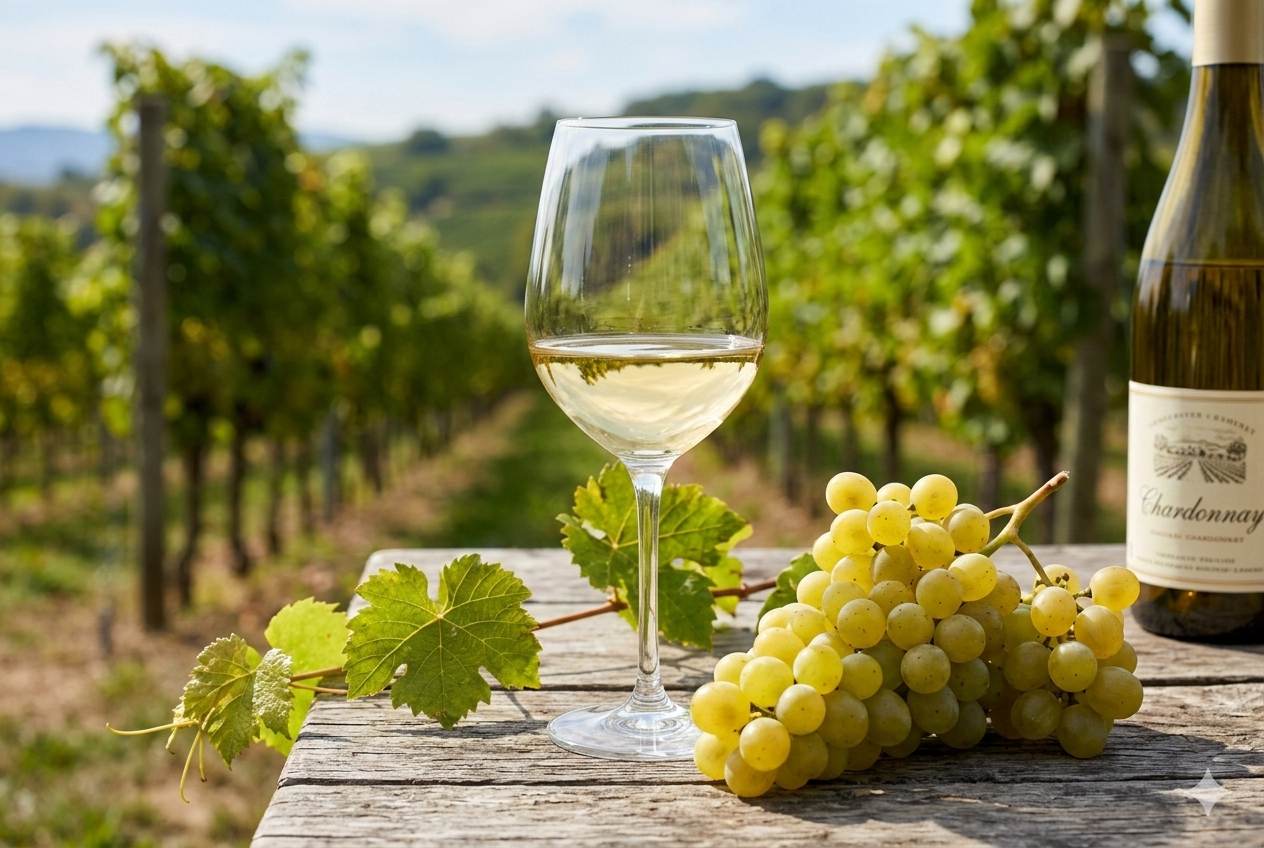
By Tim Morgan, Senior Sommelier & Contributing Editor
No grape variety in the world is more loved — or more hated — than Chardonnay.
In the 1990s, it was the most fashionable wine on earth. “ABC — Anything But Chardonnay” was the predictable backlash. Then it came back. Then it was dismissed again. Then it came back again. Chardonnay has been through more cycles of adoration and contempt than any grape in history.
The reason for this volatility is simple: Chardonnay has no fixed identity.
Pinot Noir will always taste like Pinot Noir. Riesling will always taste like Riesling. Cabernet Sauvignon will always taste like blackcurrant and cedar. But Chardonnay? Chardonnay tastes like whatever you do to it and wherever you grow it. It is wine’s blank canvas — the most terroir-transparent, most winemaker-responsive, most stylistically versatile grape variety in existence.
This is its genius. It is also why people get confused.
Identity Card
| Detail | Info |
|---|---|
| Full name | Chardonnay |
| Colour | White |
| Origin | Burgundy, France — genetically a cross of Pinot Noir × Gouais Blanc |
| Skin | Medium thickness |
| Ripening | Early to mid-season |
| Climate | Adaptable — succeeds from cool (Chablis, Champagne) to warm (California, Australia) |
| Acidity | Medium to high (climate-dependent) |
| Body | Light to full (style-dependent) |
| Global plantings | ~210,000 hectares — the world’s most planted white grape |
| Key character | Chameleon. Reflects terroir and winemaking more than any other grape. |
The Two Chardonnays
There are, broadly speaking, two completely different Chardonnay styles — and the confusion between them accounts for most of the grape’s image problems:
Style 1: Unoaked / Cool-Climate Chardonnay
LEAN, MINERAL, PRECISE

Think: Chablis, Mâconnais, Alto Adige, cool Australian, English sparkling

Aromas:
├── Green apple
├── Lemon, lime
├── Chalk, flint
├── Wet stone
├── White flowers
├── Pear
└── Saline / oyster shell

Palate:
├── Razor-sharp acidity
├── Light to medium body
├── Mineral-driven
├── Clean, precise finish
└── No oak influence

This is the Chardonnay that sommeliers love.
Style 2: Oaked / Warm-Climate Chardonnay
RICH, CREAMY, OPULENT

Think: Meursault, Montrachet, Napa, Australian (old-style), barrel-fermented

Aromas:
├── Butter, butterscotch
├── Vanilla
├── Toast, brioche
├── Tropical fruit (pineapple, mango)
├── Ripe peach
├── Hazelnut
├── Honey
└── Crème brûlée

Palate:
├── Full-bodied
├── Creamy, viscous texture
├── Buttery (from malolactic fermentation)
├── Rich, generous
├── Long, warm finish
└── Oak-influenced (vanilla, toast, spice)

This is the Chardonnay that the mass market loves — and that snobs love to hate.
The truth: Both styles can be magnificent. Both can be terrible. The style is not the quality. Lean, mineral Chablis at its best is among the greatest wines in the world. Rich, oaked Meursault at its best is among the greatest wines in the world. Cheap, over-oaked, flabby Australian Chardonnay is terrible. Cheap, thin, characterless unoaked Chardonnay is also terrible.
Judge the wine, not the style.
Where It Grows
🇫🇷 Burgundy — The Holy Land
Chardonnay’s homeland — and the place where it reaches its most profound, most complex, most terroir-expressive heights.
The Hierarchy:
| Level | Examples | Character |
|---|---|---|
| Grand Cru | Montrachet, Chevalier-Montrachet, Corton-Charlemagne, Bâtard-Montrachet | The summit. Wines of transcendent mineral complexity, extraordinary concentration, and decades of ageing potential. |
| Premier Cru | Meursault Perrières, Puligny Folatières, Chassagne Morgeot | Outstanding. Site-specific character. The sweet spot of quality and (relative) value. |
| Village | Meursault, Puligny-Montrachet, Chassagne-Montrachet, Saint-Véran | Producer-dependent but often excellent. The entry point to serious Burgundy. |
| Bourgogne Blanc | Regional | Can be stunning from top producers. The best value in white Burgundy. |
The village differences:
| Village | Character |
|---|---|
| Chablis | The mineral extreme. Unoaked (traditionally). Flinty, saline, oyster-shell. The coolest climate in Burgundy. |
| Meursault | Golden, rich, nutty, buttery. The most generous white Burgundy. |
| Puligny-Montrachet | Mineral, precise, elegant. More tension than Meursault. The purist’s choice. |
| Chassagne-Montrachet | Broader, earthier, sometimes more rustic. Often undervalued. |
| Mâconnais (Pouilly-Fuissé, Saint-Véran) | Rounder, fruitier, more immediately accessible. Excellent value. |
Essential producers: Domaine Leflaive, Coche-Dury, Roulot, Raveneau (Chablis), Dauvissat (Chablis), Bonneau du Martray (Corton-Charlemagne), Comtes Lafon, Pierre-Yves Colin-Morey.
🇫🇷 Champagne — The Invisible Star
Chardonnay is one of the three permitted Champagne grapes — and in Blanc de Blancs Champagne (100% Chardonnay), it shines most brilliantly. Blanc de Blancs from the Côte des Blancs — Le Mesnil-sur-Oger, Cramant, Avize — are among the most elegant, most mineral, most age-worthy sparkling wines in the world.
Essential: Salon, Krug Clos du Mesnil, Pierre Gimonnet, Pierre Peters, Jacques Selosse.
🇺🇸 California — The Evolution
California Chardonnay has undergone a dramatic transformation. The over-oaked, buttery, high-alcohol style that dominated the 1990s has given way to a new wave of producers making leaner, more mineral, more Burgundian wines — often from cooler sites like Sonoma Coast, Santa Rita Hills, Anderson Valley, and even the Santa Cruz Mountains.
Essential: Kistler, Peter Michael, Au Bon Climat, Sandhi, Ceritas, Domaine de la Côte, Calera.
🇦🇺 Australia — The Renaissance
Australian Chardonnay has made the same journey as California — from over-oaked and tropical to restrained, mineral, and site-driven. The best Australian Chardonnays today — from Yarra Valley, Margaret River, Adelaide Hills, and Tasmania — rival mid-level Burgundy.
Essential: Leeuwin Estate (Art Series — iconic), Giaconda, Tolpuddle, Cullen, Giant Steps.
Other Key Regions
| Region | Style | Essential |
|---|---|---|
| Alto Adige, Italy | Alpine, crisp, mineral, elegant | Elena Walch, Terlano, Tiefenbrunner |
| Jura, France | Oxidative or fresh. Unique character. | Ganevat, Tissot, Macle |
| South Africa (Elgin, Walker Bay) | Cool-climate, mineral, improving fast | Hamilton Russell, Ataraxia, Restless River |
| New Zealand (Hawke’s Bay, Marlborough) | Clean, citric, elegant | Kumeu River (Burgundy-rivalling), Craggy Range |
| Chile (Limarí, Casablanca) | Cool-climate, mineral, outstanding value | Tabalí, Casa Marín |
| Spain (Alicante — Enrique Mendoza) | Altitude Chardonnay of surprising finesse | Enrique Mendoza (see our review) |
Chardonnay and Food
Chardonnay’s stylistic range means it can pair with an enormous variety of dishes — but match the style to the food:
| Chardonnay Style | Best Pairings |
|---|---|
| Chablis / unoaked | Oysters, shellfish, sushi, goat cheese, grilled fish |
| Village Burgundy / lightly oaked | Roast chicken (THE pairing), lobster, salmon, cream sauces |
| Meursault / richly oaked | Lobster thermidor, turbot, Dover sole meunière, foie gras |
| Champagne Blanc de Blancs | Sushi, caviar, fried food, everything |
| Warm-climate / tropical | Thai food, grilled prawns, chicken satay |
How to Serve
| Detail | Recommendation |
|---|---|
| Temperature | Unoaked: 8–10°C. Oaked/Burgundy: 10–13°C. Too cold kills complexity. |
| Glass | Unoaked: standard white wine glass. Oaked/Burgundy: wider bowl — the aromatics need space. |
| Decanting | Top Burgundy benefits from 30–60 minutes of air. Pour, swirl, wait. |
| Ageing | Simple: drink within 2–3 years. Village Burgundy: 5–10 years. Premier/Grand Cru: 10–30+ years. |
The Chardonnay Redemption
If you are an “ABC” person — if you decided years ago that you don’t like Chardonnay — I have a challenge for you:
- Taste a Premier Cru Chablis (Raveneau or Dauvissat). Cold. With oysters.
- Taste a Meursault Premier Cru (Coche-Dury or Roulot). With roast chicken.
- Taste a Blanc de Blancs Champagne (Salon or Pierre Peters). With anything.
If you can taste all three and still say you don’t like Chardonnay, then you don’t like Chardonnay. Fair enough.
But I suspect that what you’ll discover is this: you never disliked Chardonnay. You disliked bad Chardonnay. And there is a lot of bad Chardonnay in the world. The good stuff, though — the real stuff, from the right places, made by people who care — is among the most beautiful wine you will ever drink.
Give it another chance. The grape has earned it.
Tim Morgan is a London-based sommelier and wine writer.