

By Tim Morgan, Senior Sommelier & Contributing Editor
Let’s start with the name, because the name is a problem.
Orange wine is not made from oranges. It is not a cocktail. It is not a flavoured wine. And it is not — despite what certain corners of the internet would have you believe — a marketing gimmick invented by Brooklyn sommeliers in 2015.
Orange wine is, in fact, the oldest method of winemaking in human history — predating red wine, predating white wine as we know it, predating barrels, bottles, corks, and civilisation itself.
It is white wine made like red wine: with extended skin contact.
When you make conventional white wine, you press the grapes immediately and ferment only the juice — discarding the skins, seeds, and stems. The result is pale, clean, and crisp.
When you make orange wine, you leave the white grape juice in contact with its skins for days, weeks, or even months — extracting colour, tannin, texture, and a spectrum of flavours that conventional white wine never touches. The result is a wine that ranges in colour from pale gold to deep amber — hence “orange” — with a texture, a structure, and a flavour profile unlike anything else in the wine world.
And the world is falling in love with it.
The Ancient Origins
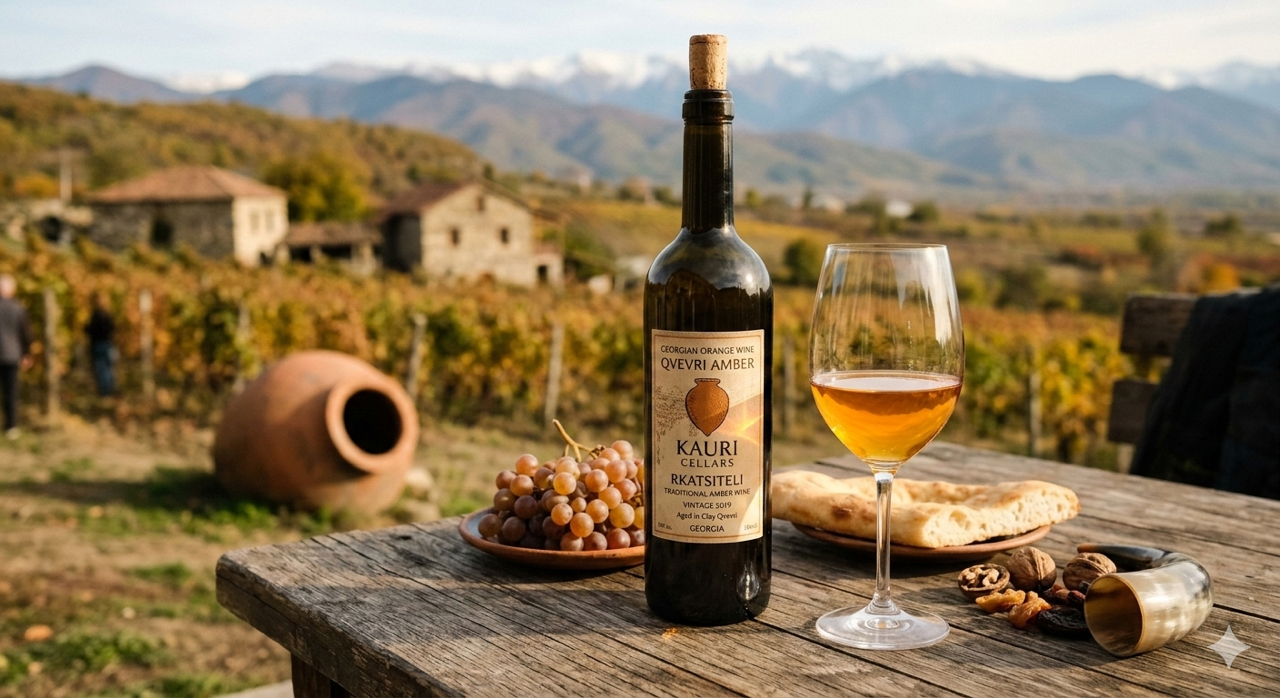
The story begins in Georgia — the country, not the American state — in the Caucasus region, where archaeological evidence places winemaking as far back as 6000 BCE. Georgian winemakers fermented their grapes — white and red alike — in large clay vessels called qvevri (pronounced KVEV-ree), buried underground. The white grapes were fermented on their skins as a matter of course. There was no concept of “pressing off” the juice. The skins were part of the wine.
This method — skin-contact white wine, fermented and aged in clay — has been continuous in Georgia for eight thousand years. It was recognised by UNESCO as an Intangible Cultural Heritage of Humanity in 2013.
For millennia, this was simply how wine was made. The modern distinction between “white wine” (no skin contact) and “red wine” (with skin contact) is a relatively recent invention — a product of industrial winemaking, temperature-controlled fermentation, and the global market’s preference for clean, predictable, easy-to-understand wines.
Orange wine is not new. White wine, as we know it, is new. Orange wine is the original.
The Modern Revival
The contemporary orange wine movement began in the 1990s, driven by two parallel forces:
1. Italy — Friuli Venezia Giulia
In the hills of Collio and Carso, on the border between Italy and Slovenia, a small group of radical winemakers began questioning everything about modern white winemaking. The pioneers — Josko Gravner, Stanko Radikon, Damijan Podversic, and others — had been making conventional whites to critical acclaim. Then they stopped.
Gravner, in particular, underwent a transformation that reads almost like a religious conversion. He travelled to Georgia, studied the qvevri method, and returned to Friuli with a radical conviction: modern winemaking had stripped white wine of its soul. Temperature-controlled stainless steel produced clean, technically correct wines that tasted of nothing — or rather, tasted the same regardless of where they came from.
He began fermenting his Ribolla Gialla on the skins for months, in Georgian qvevri buried in the earth. The resulting wines were shocking to the Italian wine establishment: amber-coloured, tannic, textured, wildly aromatic, and utterly unlike anything the market expected from white wine.
The critics were divided. Some called it genius. Others called it madness. The debate has not settled. But the movement — born in the misty hills of Friuli — had begun.
2. Slovenia — Brda
Across the border, in the Slovenian wine region of Brda (geographically and geologically identical to Collio), producers like Aleš Kristančič (Movia) and Valter Mlečnik had been making skin-contact whites for even longer — in some cases, following traditions that had never been interrupted. For them, orange wine was not a revolution. It was simply what their grandfathers had done.
3. Georgia — Rediscovery
Meanwhile, Georgia itself was emerging from decades of Soviet-era industrialisation that had nearly destroyed its ancient winemaking traditions. A new generation of Georgian winemakers — Iago Bitarishvili, Pheasant’s Tears (John Wurdeman), Lagvinari, and others — began reviving qvevri winemaking, attracting international attention and reminding the world where wine began.
Key Variables:
| Variable | Range | Effect |
|---|---|---|
| Skin contact time | 3 days to 12+ months | Longer = deeper colour, more tannin, more texture |
| Vessel | Qvevri (clay), stainless steel, oak, concrete | Clay and concrete give earthier, more mineral wines |
| Temperature | Ambient vs controlled | Ambient (natural) fermentation creates more complexity and unpredictability |
| Sulphur | None to minimal | Most orange wine producers use little or no added sulphur |
| Grape variety | Any white grape | Aromatic varieties (Muscat, Gewürztraminer, Malvasia) produce the most expressive results |
| Wild vs cultured yeast | Mostly wild/indigenous | Adds complexity, terroir expression, and risk |
What Does Orange Wine Taste Like?
This is the question everyone asks, and the honest answer is: it depends enormously on the producer, the grape, and the maceration time. The category is vast. But there are common characteristics:
Appearance: Pale gold to deep amber. Some are barely tinted; others look like a glass of aged whisky. Cloudiness is common and intentional in unfiltered examples.
Nose:
- Dried apricot, dried peach, quince
- Orange peel, mandarin, marmalade
- Honey, beeswax, chamomile
- Dried flowers, potpourri
- Hazelnuts, almonds, walnuts
- Tea (black tea, rooibos, chamomile)
- Savoury herbs, dried Mediterranean herbs
- Sometimes: farmyard, hay, cider, kombucha (in wilder examples)
Palate:
- Texture is the defining feature — orange wines have a grip, a chew, a tannic structure that no conventional white wine possesses
- Flavours tend toward dried fruit rather than fresh fruit
- Savoury rather than fruity
- Often a bitter, almond-like finish (from the seed/pip contact)
- Acidity varies but is generally firm
- Some examples have an oxidative, nutty quality reminiscent of Sherry or Vin Jaune
The key difference from conventional white wine: Conventional whites are about freshness, fruit, and acidity. Orange wines are about texture, complexity, and savoury depth. They behave more like red wines than white wines — they benefit from food pairing, they can be served at slightly warmer temperatures, and they often improve with air.
The Best Orange Wines in the World
| Wine | Region | Grape | Style | Price |
|---|---|---|---|---|
| Gravner Ribolla | Friuli, Italy | Ribolla Gialla | 5-6 months skin contact, qvevri. The benchmark. Profound. | €€€€ |
| Radikon Jakot | Friuli, Italy | Friulano | Extended maceration, no added sulphur. Wild, complex, compelling. | €€€ |
| Movia Lunar | Brda, Slovenia | Ribolla Gialla | Bottled with the lees still in (the “moon” bottle). Textural, bold. | €€€ |
| Pheasant’s Tears Rkatsiteli | Kakheti, Georgia | Rkatsiteli | Qvevri-fermented, amber, tea-like, hauntingly beautiful. | €€ |
| Iago’s Wine Chinuri | Kartli, Georgia | Chinuri | Small-production, qvevri, floral, mineral. Exquisite. | €€ |
| COS Pithos Bianco | Sicily, Italy | Grecanico | Amphora-fermented, Mediterranean, saline. | €€ |
| Dario Prinčič Jakot | Friuli, Italy | Friulano | Elegant, refined, long maceration. One of the finest. | €€€ |
| Frank Cornelissen Munjebel Bianco | Etna, Sicily | Carricante/Grecanico | Volcanic, wild, uncompromising. | €€€ |
| Gut Oggau Theodora | Burgenland, Austria | Grüner Veltliner/Welschriesling | Biodynamic, playful, characterful. | €€€ |
| Momento Mori Paint It Black | Victoria, Australia | Various | New World orange at its most creative and compelling. | €€€ |
| Kabaj Rebula | Brda, Slovenia | Rebula (Ribolla) | Traditional extended maceration. Deep, serious, age-worthy. | €€ |
How to Serve Orange Wine
| Detail | Recommendation |
|---|---|
| Temperature | Cool but not cold — 12–15°C. Warmer than white, cooler than red. |
| Glass | A medium-sized wine glass — not a narrow white wine glass (too restrictive) and not a giant Burgundy bowl (too much). |
| Decanting | Many orange wines benefit from 30–60 minutes of air. Some benefit from hours. Don’t be afraid to open them early. |
| Ageing | Good orange wines can age beautifully — 5, 10, even 20 years for the best examples. They often improve with time, gaining complexity. |
| Sediment | Unfiltered orange wines may have sediment. This is normal, natural, and not a flaw. |
Food Pairing — Orange Wine’s Superpower
Here is the dirty secret of orange wine: it is the most food-friendly style of wine in the world.
Conventional white wines struggle with rich, complex, spiced, or umami-heavy food. Conventional red wines struggle with fish, vegetables, and delicate preparations. Orange wine — with its combination of white wine acidity, red wine texture, and savoury complexity — bridges the gap.
| Food | Why It Works |
|---|---|
| Japanese cuisine | Sushi, ramen, tempura, izakaya food — the tannin and umami of orange wine love Japanese flavours |
| Korean cuisine | Kimchi, bibimbap, fried chicken — the wine’s texture stands up to fermented, spicy, complex dishes |
| Indian cuisine | Curries, tandoori, dal — the tannic structure and savoury character handle spice better than any white or red |
| Middle Eastern | Mezze, shawarma, tagine — dried fruit notes in the wine mirror the cuisine’s flavours |
| Moroccan | Tagines with dried apricot, preserved lemon, couscous — perfect bridges |
| Turkish | Manti, kebabs, lahmacun — the wine’s structure and complexity match the cuisine’s depth |
| Thai | Green curry, papaya salad, pad Thai — works where almost no other wine does |
| Ethiopian | Injera, wot, berbere-spiced dishes — the tannin and earthiness are ideal |
| Cheese | Washed-rind, semi-hard, aged — orange wine handles cheese better than almost any white |
| Charcuterie | Salumi, pâté, terrines — the tannic structure cuts fat like a red wine |
| Vegetarian/Vegan | Roasted vegetables, grain bowls, mushroom dishes — finally, a wine that takes vegetables seriously |
| Thanksgiving turkey | Arguably the perfect Thanksgiving wine — handles turkey, cranberry, stuffing, and sweet potato simultaneously |
“If you could only drink one style of wine for every meal for the rest of your life, the smartest choice — by far — would be orange wine. Nothing else comes close to its versatility.”
The Debate: Is Orange Wine a Fad?
This is the question that refuses to go away. Critics of orange wine make several arguments:
“It’s a hipster trend.”
Response: It is an 8,000-year-old winemaking method practised continuously in Georgia since before the pyramids. If it’s a trend, it’s the longest trend in human history.
“It all tastes the same — funky and oxidised.”
Response: Bad orange wine tastes funky and oxidised. Good orange wine is as varied and complex as any other category. Saying all orange wine tastes the same is like saying all red wine tastes the same because you once had a bad Merlot.
“It’s just white wine that’s gone wrong.”
Response: By this logic, red wine is just grape juice that’s been contaminated with grape skins. Skin contact is a deliberate choice — not a failure.
“It doesn’t pair with food.”
Response: The opposite is true. Orange wine pairs with more cuisines than any other wine category. See above.
“It won’t last.”
Response: It has lasted 8,000 years. It survived the Roman Empire, the Dark Ages, the Soviet Union, and the dominance of international grape varieties. It will survive Instagram.
The truth is this: orange wine is not for everyone. It is unfamiliar. It challenges expectations. It asks you to set aside what you think wine should look like, smell like, and taste like, and approach the glass with curiosity rather than assumption.
But for those willing to make that leap, orange wine offers something that no other category in wine can match: a window into the oldest, most fundamental expression of what wine is — grape juice, skin, time, and nothing more.
Where to Start
If you’ve never tasted orange wine, begin here:
| Level | Wine | Price | Why |
|---|---|---|---|
| Beginner | Pheasant’s Tears Rkatsiteli (Georgia) | €€ | Accessible, balanced, beautiful. The gateway. |
| Curious | COS Pithos Bianco (Sicily) | €€ | Mediterranean warmth, gentle tannin, easy to love. |
| Intermediate | Radikon Jakot (Friuli) | €€€ | More challenging. Deeper. Rewarding. |
| Advanced | Gravner Ribolla (Friuli) | €€€€ | The masterwork. Profound, complex, life-changing. |
| Adventurous | Frank Cornelissen Munjebel Bianco (Etna) | €€€ | Wild, volcanic, uncompromising. Not for the faint-hearted. |
The Future
Orange wine currently represents a tiny fraction of global wine production — perhaps 1–2% at most. But its influence is vastly disproportionate to its market share. It has changed the way sommeliers think about food pairing. It has inspired conventional white wine producers to experiment with skin contact. It has brought attention to forgotten grape varieties and ancient winemaking methods. And it has opened a door to wine cultures — Georgian, Slovenian, Croatian, Greek — that the mainstream wine world had ignored for decades.
The genie is out of the qvevri. It is not going back in.
Tim Morgan is a London-based sommelier and wine writer.