

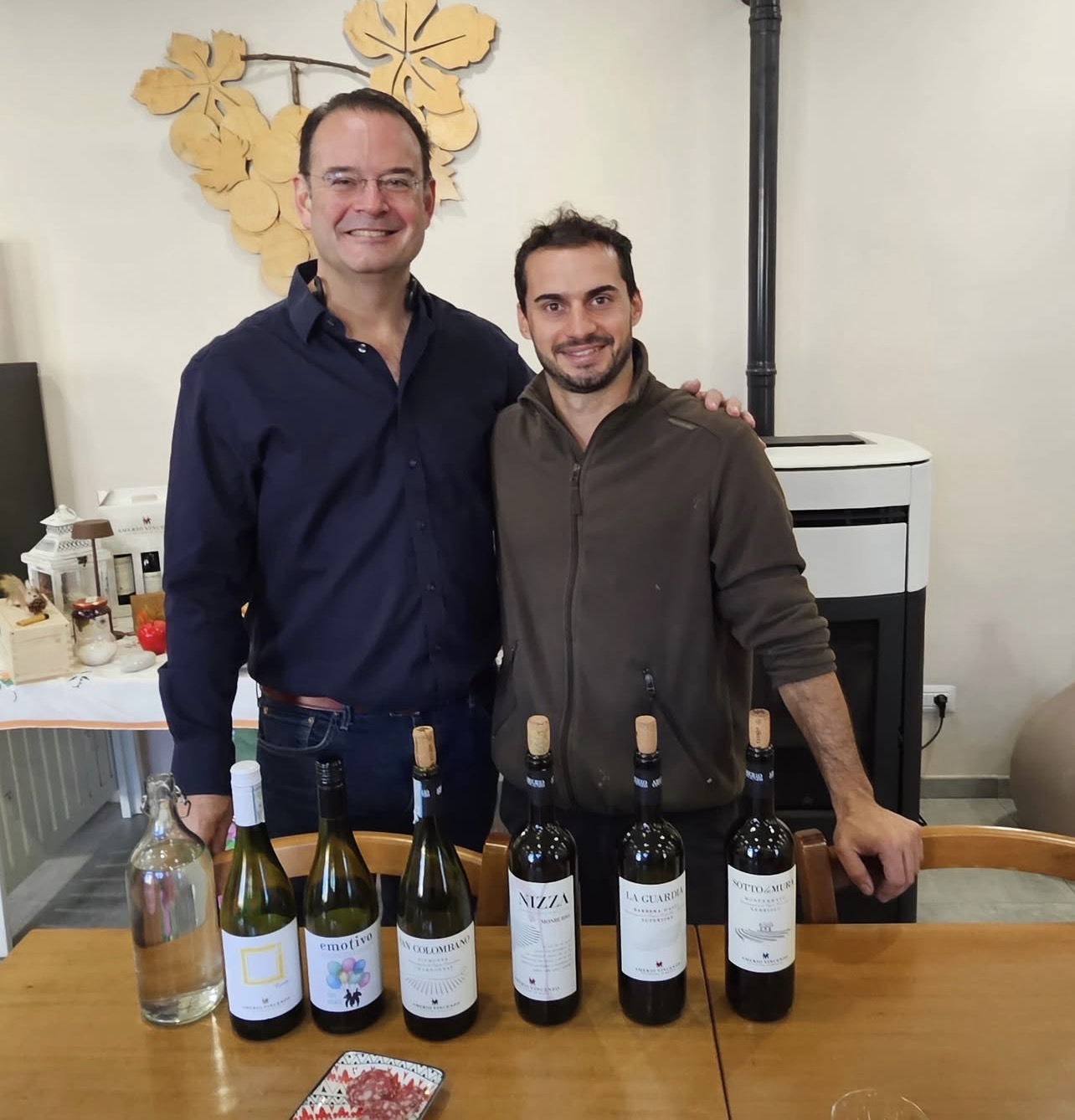
By Tim Morgan, Senior Sommelier & Contributing Editor
I need to tell you about something. And I need you to listen carefully, because this is the kind of story that doesn’t come along very often.
Last year, I found myself in Piedmont on one of those detours that happen when you follow a tip from a local — a name scribbled on a napkin, a vague set of directions, and the words “you have to go there.” The name was Amerio Vincenzo. I had never heard of it. No one I knew had ever heard of it. There was no entry in any guide I owned.
I went. I tasted. And something happened that hasn’t happened to me in years: I ran out of words.
That was 5 months ago. In the intervening year, I have thought about those wines more than I care to admit. I have described them to colleagues, to friends, to strangers at tastings who made the mistake of asking me what I’d been drinking lately. I have lain awake thinking about the Barbera. I have dreamed about the Barolo.
So I went back.
I had to go back.
And the second visit confirmed everything the first one promised: Amerio Vincenzo is one of the most exciting discoveries I have made in three decades of tasting wine. Not in Piedmont. Not in Italy. Anywhere.
The Story: From Grape Growers to Winemakers
Here is what makes this story even more remarkable.
For generations, the Amerio family did not make wine. They grew grapes. They were conferitori — grape growers who sold their fruit to the famous names of Piedmont. The celebrated estates, the ones whose bottles line the shelves of fine wine shops from London to Tokyo, the ones whose Barolos fetch hundreds of euros — many of them, for years, were buying grapes from families exactly like the Amerios.
Think about that for a moment. The raw material — the fruit, the terroir, the decades of viticultural knowledge passed from parent to child — was always there. It was always world-class. It was simply wearing someone else’s label.
Then the new generation made a decision that changed everything.
They decided to stop selling. They decided to keep the grapes. They decided to make their own wine.
It was a brave decision. Starting a winery from scratch — even with generations of farming knowledge behind you — is a financial risk, a logistical challenge, and a leap of faith. The infrastructure must be built. The market must be found. The reputation must be earned from zero.
But the Amerios had something that no amount of investment can buy: vines that had been tended with love for decades, in some of Piedmont’s finest terroir, by people who knew every row, every slope, every microclimate as intimately as they knew the rooms of their own home.
The grapes were always exceptional. They just needed a family brave enough to put their own name on the bottle.
And which wine they made. My God, which wine.
The Estate
The Amerio family farms their vineyards with the kind of meticulous, instinctive care that only comes from generational knowledge. These are not people who learned viticulture from a textbook. They learned it from their parents, who learned it from their parents, who learned it from the land itself.
The yields are kept deliberately low. The farming is attentive and respectful — responsive to the rhythms of each season, each parcel, each vine. There is no formula here. There is only observation, experience, and an intimate understanding of the terroir that has been refined over a lifetime.
The cellar is not a showpiece. There are no architects. No tasting lounges with panoramic views designed for Instagram. There is oak — traditional, well-maintained, doing its quiet work. There is concrete. There are bottles ageing in patient silence. And there is a family that pours their wine with the same hands that pruned the vines, and watches your face as you taste with a mixture of fierce pride and genuine, almost tender curiosity.
This is what Piedmont looked like before the world discovered it. This is what Piedmont still looks like, if you know where to look.
The Wines
I tasted through the entire range — twice now, a year apart. The consistency is remarkable. The quality is staggering. What follows is not a polite summary. It is a love letter.
🍷 Amerio Vincenzo Dolcetto
Grape: 100% Dolcetto
Alcohol: 13%
Ageing: Stainless steel, brief period in oak
Tim Morgan’s Score: 89/100 ⭐ Editor’s Pick — Best Value
I have tasted hundreds of Dolcettos. Most are pleasant. Some are good. A rare few make you stop and pay attention. This one made me put down my pen and simply drink.
Nose: Immediately joyful. An explosion of ripe dark cherry, crushed blueberry, and fresh violets — so vivid, so primary, so alive that it feels like biting into fruit straight from the tree. Beneath the fruit, a savoury undercurrent: bitter almond, a hint of dark chocolate, a whisper of fresh herbs. There is no oak influence, no winemaking artifice — just pure, unadulterated grape, captured at the perfect moment of ripeness.
Palate: This is where I fell in love — again. The wine enters the mouth with a burst of juicy, almost explosive fruit — black cherry, blueberry, damson — carried by soft, velvety tannins and a bright, mouth-watering acidity that makes your salivary glands sing. It is medium-bodied but generous, warm but fresh, simple but deeply satisfying. There is a bittersweet almond note on the mid-palate that is classic Dolcetto — and here it is rendered with a clarity and precision that elevates it from everyday to extraordinary.
Finish: Medium, clean, with a pleasant bitter-cherry and almond lift. The kind of finish that makes you immediately reach for another sip. And another. And another. The bottle was in danger — both times.
Food pairing: Tajarin with butter and sage. Fresh egg pasta with ragù. Vitello tonnato. Antipasti. Salumi. Pizza. Tuesday night. Wednesday night. Every night. This is the wine you want in your fridge at all times — the wine that makes ordinary dinners feel like celebrations.
The verdict: A great Dolcetto, made with this much care and authenticity, can be one of the most pleasurable wines in all of Italy. Not the most complex. Not the most age-worthy. But the most purely, uncomplicated, heart-swellingly enjoyable. Amerio’s Dolcetto is exactly that. At its price, it is not merely good value — it is an act of generosity.
“I came to taste Barolo. The Dolcetto nearly made me forget why. This is joy in a glass — the kind of wine that reminds you why you fell in love with wine in the first place.”
— Tim Morgan
🥂 Amerio Vincenzo Moscato Secco (Dry Moscato)
Grape: 100% Moscato Bianco
Alcohol: 12.5%
Style: Dry (secco)
Ageing: Stainless steel
Tim Morgan’s Score: 91/100 ⭐ Editor’s Pick — Revelation
Stop. Read that again. Dry Moscato.
I know what you’re thinking. Moscato is sweet. Moscato is Moscato d’Asti — fizzy, low-alcohol, the wine you pour for people who say they don’t like wine. Moscato is dessert in a glass. It is not a serious wine.
Wrong. Completely, spectacularly, gloriously wrong.
What Amerio Vincenzo has done with Moscato Bianco in a dry style is one of the most thrilling things I have encountered in Italian white wine in years. This wine took everything I thought I knew about the grape, turned it upside down, shook it, and handed it back as something entirely new.
Nose: Dazzling. Intoxicating. Almost overwhelmingly beautiful. The aromatic intensity of Moscato Bianco is legendary — it is one of the most powerfully perfumed grapes in the world — and in this dry interpretation, freed from sweetness, the aromatics are liberated. They soar. White peach, apricot blossom, orange blossom, jasmine, honeysuckle, lychee, fresh ginger, a hint of sage, rose water, musk. Layer upon layer of floral and stone-fruit perfume, so vivid and so complex that the nose alone is worth the price of the bottle. This is what Moscato is supposed to smell like when it has nothing to hide behind.
Palate: And here is the revelation. Without residual sugar to lean on, the wine must stand on its own — on structure, on acidity, on texture — and it does so magnificently. The entry is silky and aromatic, with those extraordinary floral and stone-fruit notes flooding the palate. But instead of sweetness, there is a bright, crisp, almost electric acidity that gives the wine tension and drive. The mid-palate brings a saline minerality — a sense of the soil, of the Piedmontese hills — that grounds the exuberant aromatics and gives the wine a seriousness that no sweet Moscato can match. The texture is light but precise, with a faint oily quality that speaks of ripe fruit and careful winemaking.
Finish: Medium-long, dry, with a persistent floral echo — rose petal, orange blossom — and a clean, mineral close. You swallow, and the perfume lingers in the air around you, as if the wine has scented the room itself.
Food pairing: This is a stunning aperitivo — possibly the most beautiful aperitif wine I know. Beyond that: fresh seafood — raw crudo, carpaccio di tonno, grilled langoustines. Thai food — green curry, papaya salad — where the wine’s aromatics dance with the spice. Fresh goat cheese with honey and herbs. Sushi. Ceviche. And — I tried this on my second visit and nearly wept — with a plate of the family’s own fresh focaccia, warm from the oven, drizzled with olive oil. Wine, bread, sunlight. The best things in life.
The verdict: This is the wine I have been talking about most since my first visit. Not the Barolo — I’ll get there — but this dry Moscato, because it represents something genuinely new. It is a wine that challenges assumptions, that reimagines a grape most of the world has underestimated, and that delivers an experience so unique and so beautiful that it deserves to be talked about on the global stage. I have tasted dry Moscatos from other producers. None of them come close to this. Amerio Vincenzo has, almost casually, produced one of the most original and exciting white wines in Italy.
“I have poured this wine for three Master Sommeliers. All three asked for a second glass. All three asked where to buy it. One of them said, and I quote: ‘This is the most interesting white wine I’ve tasted this year.’ I agree.”
— Tim Morgan
🍷 Amerio Vincenzo Barbera
Grape: 100% Barbera
Alcohol: 14%
Ageing: Oak (mix of large and small barrels)
Tim Morgan’s Score: 92/100 ⭐ Editor’s Pick
If the Dolcetto was love at first sight and the Moscato was a revelation, the Barbera was a slow, deepening embrace — the kind of wine that gets better with every sip, that unfolds and expands and refuses to let you stop thinking about it.
Remember: for generations, the Amerio family sold these very grapes to famous Piedmontese estates. Those estates turned them into acclaimed wines. Now the family is making the wine themselves — from the same vines, the same terroir, the same generational expertise — and the result is better. Because no one knows these vines like they do. No one.
Nose: Dark, brooding, and immediately compelling. Ripe morello cherry — not the bright, fresh cherry of the Dolcetto, but a deeper, darker, more serious expression. Black cherry compote. Crushed plum. Then layers: dried Mediterranean herbs — oregano, thyme — a hint of leather, tobacco, warm earth, a touch of spice from the oak — clove, nutmeg — and beneath everything, a vein of iron minerality that runs through the wine like a family signature. This nose has depth. Give it time. It rewards patience generously.
Palate: Magnificent. This is Barbera at its most thrilling — the acidity is electric, searing, almost shockingly bright, cutting through the rich, concentrated fruit like a blade of light through darkness. And what fruit: dark cherry, blackberry, plum jam, a touch of fig — dense and generous but lifted, always lifted, by that extraordinary acidity that is Barbera’s gift to the wine world. The tannins are soft — Barbera’s tannins always are — but there is a structure here that comes not from tannin but from acid and mineral, creating a wine of real architecture and purpose. The oak is perfectly judged — present but not dominant, adding warmth and spice without ever obscuring the grape’s natural brilliance.
Finish: Long and vibrant. Sour cherry, dark chocolate, a hint of smoky espresso, and a mineral persistence that keeps the flavours alive on the palate long after swallowing. The finish has energy — a sense of forward motion, of vitality, of life.
Food pairing: This is the ultimate Italian food wine. Braised beef in Barbera. Fresh egg pasta with a long-cooked ragù — the kind that simmers for six hours until the meat dissolves. Bollito misto with salsa verde. Risotto with porcini mushrooms. Roasted pork loin with rosemary. Aged Toma cheese. And — this is important — it is the wine I would choose for the most important Italian pairing of all: Sunday lunch with family. Because this is a wine made by a family, for families.
The verdict: There is a special place in wine heaven reserved for great Barbera — wines that combine that unmistakable cherry-sour acidity with depth, complexity, and soul. Amerio’s Barbera does not just occupy that place. It furnishes it, moves in, and invites the neighbours over. This is one of the finest Barberas I have tasted in years, from any producer, at any price. The fact that it costs what it costs is almost unfair to the competition.
“Barbera is Italy’s most underrated great grape. And this — this — is why. Taste this wine and try to tell me that Barbera doesn’t belong in the conversation with the world’s finest reds. I dare you.”
— Tim Morgan
🍷 Amerio Vincenzo Nebbiolo
Grape: 100% Nebbiolo
Alcohol: 14%
Ageing: Traditional oak ageing
Tim Morgan’s Score: 93/100 ⭐ Editor’s Pick
Now we enter Nebbiolo territory — the grape that built Piedmont’s reputation, the grape that produces Barolo and Barbaresco, the grape that is arguably the most difficult, the most demanding, and the most rewarding red variety on earth.
Many producers’ Nebbiolo — the “entry-level” wine below their Barolo — is an afterthought. A diluted preview. A compromise.
Not here. Not at Amerio Vincenzo. This Nebbiolo is a statement. A declaration that the new generation isn’t just making wine — they are making wine that stands, without apology, among the best.
Nose: Oh, this is beautiful. The classic Nebbiolo perfume — dried rose petals, wild strawberry, tar, crushed violets — is here in all its haunting, ethereal glory, but with a freshness and vibrancy that I associate with the very best expressions of the grape. Give it twenty minutes of air. Then come back. Now: dried cherry, orange peel, star anise, a hint of camphor, leather, wet earth, truffle — yes, truffle, that unmistakable Piedmontese earthiness that smells like autumn in the Langhe. The complexity is remarkable for a “simple” Nebbiolo. This nose belongs to a wine at twice the price.
Palate: Nebbiolo’s paradox is on full display: the colour is pale — barely darker than a deep rosé — but the flavour is enormous. Cherry, raspberry, pomegranate, blood orange, dried herbs, liquorice, tar. The tannins are classic Nebbiolo — firm, fine-grained, chalky, coating the mouth with a gentle but insistent grip that speaks of structure and ageing potential. The acidity is bright and precise — a steel thread running through the centre of the wine, holding everything together with architectural clarity. There is an elegance here, a refinement, that belies the wine’s humble position in the range.
Finish: Long, perfumed, with lingering notes of rose, tar, bitter almond, and fine tannin. The finish of a serious wine — one that asks you to sit down, pay attention, and give it the respect it deserves.
Food pairing: Agnolotti del plin — the tiny, hand-pinched pasta parcels of Piedmont, filled with roasted meat and dressed in butter and sage. Braised rabbit with olives. Veal with tuna sauce. Risotto al Barolo. Tajarin with white truffle — yes, this Nebbiolo has the complexity and perfume to stand beside truffle.
The verdict: This is a Nebbiolo of astonishing quality. It drinks like a baby Barolo — all the hallmarks are there: the perfume, the structure, the tannic architecture, the extraordinary aromatic complexity — at a fraction of the cost and with more immediate accessibility. And knowing that these are the same vines, the same family, the same terroir that was once feeding someone else’s famous label — there is a poetic justice in the fact that the wine has never been better than it is now, under the family’s own name.
“I have tasted Nebbiolo from the most famous estates in Piedmont. Amerio’s stands among them without flinching. This is not an entry-level wine pretending to be something it isn’t. It is a magnificent Nebbiolo that knows exactly what it is — and what it is, is extraordinary.”
— Tim Morgan
🍷 Amerio Vincenzo Barolo
Grape: 100% Nebbiolo
Alcohol: 14.5%
Ageing: Extended ageing in traditional Slavonian oak botti
DOCG: Barolo
Tim Morgan’s Score: 95/100 🏆 Exceptional
And here it is. The summit. The king of wines and the wine of kings.
I want to be careful with what I say here, because it is a serious claim: Amerio Vincenzo’s Barolo is one of the most exciting wines I have tasted in Piedmont in the last five years. Not because it is the most powerful. Not because it is the most concentrated or the most extracted or the most obviously impressive. But because it is the most honest.
There is something almost unbearably moving about tasting this wine when you know the story behind it. For decades — decades — these grapes went into other people’s bottles. Other people’s reputations were built on fruit from these vines. The Amerio name appeared on no label. Their terroir spoke, but in someone else’s voice.
Now the voice is their own. And it is magnificent.
Nose: Transcendent. The aromatics alone justify the price of the bottle — you could spend an evening with just the nose and feel that your time was well spent. Dried rose, tar, cherry liqueur, camphor, dried sage, star anise, truffle, leather, tobacco, wet stone, a hint of mentholated eucalyptus, dried blood orange, sandalwood, iron filings, aged balsamic, potpourri. The complexity is not just impressive — it is moving. This is a nose that tells a story: of a specific place, a specific year, a specific family’s relationship with their vines. Every great Barolo nose does this. Very few do it with this much eloquence.
Palate: The entry is deceptively gentle — a soft wave of red fruit, translucent and luminous. Then the structure arrives. Nebbiolo’s legendary tannins unfold across the palate — firm, fine, persistent, architectural — creating a framework of almost gothic grandeur within which the flavours arrange themselves with patient precision. Cherry, pomegranate, wild strawberry, bitter almond, liquorice, dried herbs, tar, iron. The acidity is extraordinary — knife-sharp, crystalline, giving the wine a lift and an energy that contradicts its depth and concentration. This is the paradox of great Barolo: simultaneously powerful and ethereal, dense and weightless, stern and beautiful.
And then, somewhere in the mid-palate, something happens that only the greatest wines achieve: the flavours stop being individual notes and become something unified — a single, seamless, multidimensional experience that is more than the sum of its parts. The wine stops being a wine and becomes a place. You are standing in the Langhe. The fog is rolling in. The harvest is done. And the wine in your glass is the memory of everything that happened to bring this moment into being.
Finish: Monumental. Four minutes. Perhaps five. Waves of rose, tar, bitter cherry, iron, and fine tannin that ebb and flow with a rhythm that feels almost tidal. The finish is not aggressive — it is patient, persistent, and profoundly beautiful. It is the finish of a wine that was built not for this year, or next year, but for a decade or two from now — though it already offers profound rewards for those willing to decant it and give it time.
Food pairing: This demands the finest table Piedmont can offer. Tajarin al tartufo bianco — fresh egg pasta with white truffle, and nothing else. Brasato al Barolo — beef braised for hours in the same wine. Agnolotti del plin in brodo. Finanziera. Aged Castelmagno. This is a wine for the most special of occasions — not because it demands formality, but because it deserves attention.
The verdict: I am going to say this plainly, because I believe it: Amerio Vincenzo’s Barolo belongs in the same conversation as Piedmont’s most celebrated estates. It has the aromatic complexity, the structural integrity, the terroir transparency, and the emotional depth of wines costing three, four, five times as much. And the story — generations of growing grapes for others, before a brave new generation decided to claim their own voice — makes every sip taste like vindication.
Buy it. Buy as much as you can. Cellar half of it. Drink the other half with the people you love. And when the big names raise their prices again next year, remember that here, in a quiet cellar in Piedmont, a family called Amerio is making Barolo that stands among the best. For a price that feels like a gift.
The world will discover them eventually. Be there first.
“In thirty years of tasting wine, the greatest discoveries have never been the famous bottles. They have been the unknown ones — the wines that arrive without fanfare and leave you fundamentally changed. Amerio Vincenzo’s Barolo is one of those wines. I tasted it, and I sat in silence. That is the highest compliment I know how to pay.”
— Tim Morgan
🥃 Amerio Vincenzo Grappa
Distilled from: Nebbiolo and Moscato pomace
Alcohol: ~42%
Style: Artisanal, small-batch
Tim Morgan’s Score: Not scored (spirit) — but: TO DIE FOR 🏆
I almost didn’t include this. Grappa is not wine. It falls outside my usual remit. But to visit Amerio Vincenzo and not write about the grappa would be a lie of omission — because it is, without exaggeration, one of the finest grappas I have ever tasted.
Let me be blunt: most grappa is terrible. It is harsh, industrial, fiery, and tastes like someone set fire to a chemistry lab. It is the spirit that tourists drink once, regret immediately, and never order again. The reputation is, for the most part, deserved.
And then there is this.
Nose: Extraordinary. Where most grappa smells of alcohol and aggression, Amerio’s smells of fruit. Fresh grape must. Rose petals. Pear. A hint of hazelnut. Honey. The Moscato pomace contributes an intoxicating floral perfume — orange blossom, jasmine — while the Nebbiolo adds structure and earthy depth. It smells, impossibly, like the vineyard itself — like standing among the vines at harvest, when the air is thick with the scent of ripe grapes and warm earth.
Palate: Silk. Not fire. Not acid. Silk. The alcohol is perfectly integrated — warm, round, enveloping — carrying flavours of dried apricot, toasted almond, vanilla, rose petal, and a clean, grape-skin bitterness that gives it backbone and authenticity. There is a richness and a smoothness here that speaks of careful distillation — slow, patient, attentive — and of pomace that was fresh and pristine when it entered the still.
Finish: Long, warm, gently fading into notes of honey, dried flowers, and a faint, beautiful bitterness. The kind of finish that makes you close your eyes and exhale slowly.
How to drink it: In a small tulip glass, at room temperature, after dinner. Sip it slowly. Let it breathe. Do not shoot it. Do not ice it. Give it the respect it deserves. This is not bar grappa. This is an artisanal spirit of extraordinary quality, made by the same hands that made the wines you have just been drinking, from the same grapes, from the same land.
The verdict: I have a confession. On my first visit last year, after tasting through the wines, the family poured me a glass of their grappa almost as an afterthought — the way Piedmontese families do, as a gesture of hospitality, a farewell embrace. I took a polite sip expecting the usual burn. Instead, I experienced something so unexpectedly refined, so elegant, and so delicious that I asked for a second glass immediately. And then a third. I left with two bottles.
When I returned this year, the first thing I said was: “Before we start — may I have a glass of the grappa?”
They laughed. They understood. They poured.
“If every grappa in Italy tasted like this, grappa would be the most celebrated spirit in the world. It isn’t — because most grappa is nothing like this. Amerio’s is in a different universe. It is, and I choose these words deliberately, to die for.”
— Tim Morgan
Summary Table
| Wine | Score | Price | Verdict |
|---|---|---|---|
| Dolcetto | 89 ⭐ | € | Pure joy. Best value wine in Piedmont. |
| Moscato Secco | 91 ⭐ | € | Revelation. Most original white in Italy. |
| Barbera | 92 ⭐ | €€ | Electric. One of the finest Barberas anywhere. |
| Nebbiolo | 93 ⭐ | €€ | Baby Barolo quality. Astonishing at the price. |
| Barolo | 95 🏆 | €€€ | World-class. A Barolo for the ages. Buy now. |
| Grappa | 🏆 Unscored | €€ | To die for. Best artisanal grappa I’ve tasted. |
The Estate
| Detail | Info |
|---|---|
| Name | Amerio Vincenzo |
| Location | Piedmont, Italy |
| Region | Langhe |
| History | Multi-generational grape growers; new generation now producing their own wine |
| Grapes | Dolcetto, Moscato Bianco, Barbera, Nebbiolo |
| Also produces | Artisanal grappa (Nebbiolo/Moscato pomace) |
| Style | Traditional, family-run, minimal intervention |
| Visits | By appointment — intimate, personal, unforgettable |
Why You Should Care
I want to tell you why this story matters — not just for the wines, but for what they represent.
In Piedmont, as in every great wine region, there is an invisible economy behind the famous labels. The big names — the ones you know, the ones that win the scores and fill the auction catalogues — are often built, at least in part, on grapes bought from small growers. Families like the Amerios. Families who tend the vines, who know the land, who do the hardest, most unglamorous work in the wine chain — and whose names never appear on the bottle.
This is the way it has always been. And for many growers, it is a perfectly good arrangement — a reliable income, a steady buyer, a simple life.
But sometimes — rarely, beautifully — a new generation looks at the grapes their family has grown for decades and asks a dangerous, thrilling question: What if we made the wine ourselves?
The Amerio family asked that question. And their answer is in the glass.
It is not a tentative answer. It is not a “first attempt” that shows “promise.” It is a full-throated, emphatic, spectacular answer — a range of wines that would be remarkable from an established estate with a century of winemaking history, and that is almost miraculous from a family making their first vintages.
Because the truth is this: the knowledge was always there. The terroir was always there. The quality was always there. It was simply waiting for someone brave enough to claim it.
I visited last year and was shaken. I returned this year and was confirmed. I am already planning my next visit — because I know, with the certainty that only comes from tasting something genuinely great, that these wines are going to get even better. The new generation is just getting started. The vines are mature. The learning curve is steep and fast. The best is yet to come.
Remember this name: Amerio Vincenzo.
In five years, you will not be able to buy their Barolo without a waiting list. In ten years, the world will know them. In twenty years, they will be one of the estates that people point to and say: “I wish I had discovered them early.”
You can discover them now. Do not wait.
Tim Morgan is a London-based sommelier and wine writer specialising in Italian and Mediterranean wine regions. He has visited Amerio Vincenzo twice and will return. He left with grappa both times.