

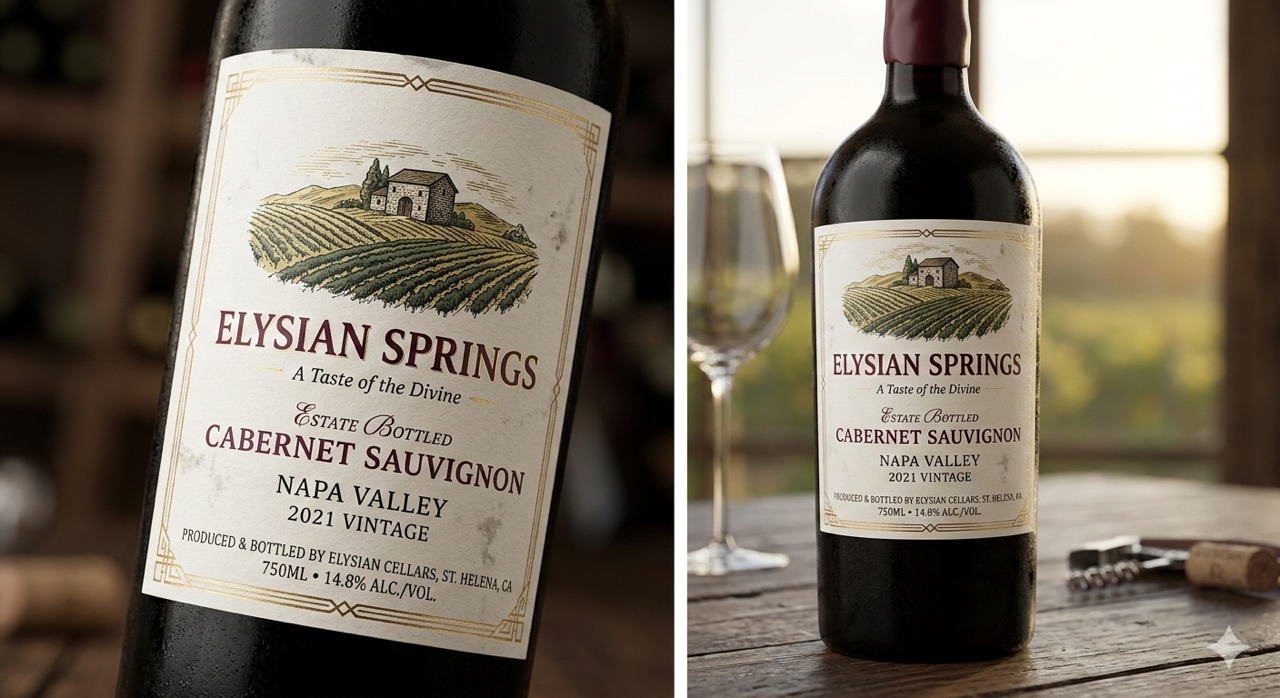
A wine label should tell you everything you need to know before you open the bottle. The problem is that it often tells you in a language you don’t speak, using a system you don’t understand. Here is the translation guide — country by country, word by word.
By Tim Morgan, Sommelier & Contributing Editor
Wine labels are the wine industry’s worst marketing failure.
They are designed — in theory — to inform you. To tell you what is in the bottle, where it came from, who made it, and what to expect. In practice, they are a baffling patchwork of foreign languages, arcane classifications, cryptic abbreviations, and decorative fonts that tell you almost nothing unless you already know what you’re looking for.
A bottle of French Burgundy might say “Gevrey-Chambertin Premier Cru” without mentioning the word Pinot Noir anywhere. A bottle of German Riesling might say “Spätlese Trocken” without explaining whether the wine is sweet or dry. A bottle of Italian Barolo might say “DOCG” without telling you what those letters mean.
This guide will decode all of it. Country by country. Word by word. So that the next time you pick up a bottle, you will know exactly what you are holding.
THE ANATOMY OF A WINE LABEL
Every wine label in the world, regardless of country, contains some combination of these elements. Not all are always present, but these are the pieces of information you may encounter.
Producer or estate name — Who made the wine. This is often the most prominent text on the label. Examples: Château Margaux, Domaine Leflaive, Bodegas Enrique Mendoza, Ridge Vineyards.
Region or appellation — Where the grapes were grown. This can be very broad (France, South Australia) or very specific (Puligny-Montrachet Premier Cru Les Folatières). Generally, the more specific the region, the higher the quality — because stricter rules apply.
Grape variety — What the wine is made from. New World wines (Americas, Australia, New Zealand, South Africa) almost always list this prominently. Old World wines (Europe) often do not — they expect you to know the grape from the region.
Vintage — The year the grapes were harvested. This tells you the age of the wine and, for knowledgeable buyers, the quality of the growing season. Non-vintage (NV) wines — most commonly Champagne and some fortified wines — are blends of multiple years.
Classification or quality level — A legal designation indicating where the wine sits in a quality hierarchy. This varies enormously by country — AOC in France, DOCG in Italy, DO in Spain, Prädikat in Germany.
Alcohol level — Expressed as a percentage of alcohol by volume (ABV). Legally required in most countries. Tells you something about the wine’s body and style — 7.5% is light and delicate, 14.5% is full and powerful.
Volume — Almost always 750ml for a standard bottle. Also common: 375ml (half bottle), 1500ml (magnum).
FRANCE
French wine labels are the most intimidating in the world, because they prioritise place over grape. The assumption is that the place name tells you everything — which grapes are used, what style the wine will be, and where it sits in the quality hierarchy. This is elegant if you know the system. It is impenetrable if you don’t.
The Quality Hierarchy
AOP (Appellation d’Origine Protégée) — Formerly AOC (Appellation d’Origine Contrôlée). The highest classification. The wine must come from a specific defined region, use permitted grape varieties, follow strict winemaking rules, and meet quality standards. Most fine French wine carries this designation. When a label says “Chablis” or “Saint-Julien” or “Châteauneuf-du-Pape,” it is an AOP wine.
IGP (Indication Géographique Protégée) — Formerly Vin de Pays. A step below AOP. Still regionally defined, but with more flexible rules — winemakers can use a wider range of grapes and techniques. IGP wines can be excellent and often represent great value. Vin de Pays d’Oc (Languedoc) is one of the largest and most reliable IGP categories.
Vin de France — The most basic classification. Wine from anywhere in France, with very few restrictions. Can be simple table wine or, increasingly, adventurous wines from producers who deliberately work outside the appellation system.
Burgundy Labels
Burgundy has its own internal hierarchy, which appears on the label in addition to the AOP designation.
Grand Cru — The highest level. The vineyard name appears prominently, often without the village name. Example: a label that says “Chambertin” or “Le Montrachet” without saying “Gevrey-Chambertin” or “Puligny-Montrachet” is a Grand Cru. These are the most prestigious and expensive wines.
Premier Cru (1er Cru) — The second-highest level. The label will show the village name followed by the vineyard name, with the words “Premier Cru” or “1er Cru.” Example: “Gevrey-Chambertin Premier Cru Clos Saint-Jacques.”
Village — Wine from a specific village but not from a classified vineyard. The label shows only the village name. Example: “Gevrey-Chambertin” or “Meursault.”
Regional (Bourgogne) — Wine from the broader Burgundy region. The label says “Bourgogne” followed by the colour — Bourgogne Rouge (red Pinot Noir) or Bourgogne Blanc (white Chardonnay). This is entry-level Burgundy, but from a good producer it can be excellent.
Bordeaux Labels
Bordeaux uses a different system based on property (château) classification rather than vineyard hierarchy.
The famous 1855 Classification ranked the top Left Bank estates into five tiers — Premier Cru (First Growth) through Cinquième Cru (Fifth Growth). These rankings have barely changed in nearly 170 years. The five First Growths are Lafite Rothschild, Latour, Margaux, Haut-Brion, and Mouton Rothschild.
Cru Bourgeois is a classification for high-quality estates that sit just below the classified growths. These wines often represent excellent value.
The label on a Bordeaux bottle will typically show the château name, the appellation (e.g., Pauillac, Saint-Julien, Margaux, Pessac-Léognan), and the vintage. The grape varieties are almost never listed — you are expected to know that Left Bank Bordeaux is dominated by Cabernet Sauvignon and Right Bank by Merlot.
Champagne Labels
Brut — Dry. The most common style. Less than 12 grams of residual sugar per litre.
Extra Brut — Very dry. Less than 6 grams.
Brut Nature or Zero Dosage — Bone dry. No sugar added after disgorgement.
Demi-Sec — Medium-sweet. Despite the name (which literally means “half-dry”), these are noticeably sweet.
Blanc de Blancs — Made entirely from white grapes (Chardonnay). Tends to be elegant, mineral, and refined.
Blanc de Noirs — Made entirely from black grapes (Pinot Noir and/or Meunier). Tends to be richer, fuller, and more vinous.
Rosé — Pink Champagne. Made either by blending a small amount of still red wine into white Champagne, or by brief skin contact with red grapes.
Vintage — From a single year. Only produced in exceptional years. Typically more complex and age-worthy than non-vintage.
NV (Non-Vintage) — A blend of multiple years. The house’s signature style, designed for consistency.
Grand Cru — Grapes from one of the 17 villages rated 100% on the historical échelle des crus. These are considered the finest vineyard sites in Champagne.
Premier Cru — Grapes from villages rated 90–99%.
Other French Terms You’ll See
Domaine — An estate that grows its own grapes and makes its own wine. The word implies self-sufficiency and is generally associated with artisanal, hands-on production.
Château — Literally “castle,” but in wine terms it simply means a wine estate. Used primarily in Bordeaux. The estate does not need to have an actual castle.
Négociant — A merchant who buys grapes or wine from growers and produces wine under their own label. Not inherently better or worse than a domaine — some of the greatest Burgundy producers (like Louis Jadot or Joseph Drouhin) are négociants.
Mis en bouteille au château / au domaine — “Bottled at the estate.” Indicates that the wine was made and bottled by the producer, not sold in bulk and bottled elsewhere.
Vieilles Vignes — “Old vines.” There is no legal definition of how old the vines must be, but the implication is that older vines produce more concentrated, complex wine. Generally a positive indicator.
Réserve — In France, this term has no strict legal definition (unlike in Spain or Italy). It may indicate a superior cuvée, or it may mean nothing at all. Judge by the producer, not the word.
Cuvée — A batch or blend of wine. “Cuvée Prestige” or “Grande Cuvée” usually indicates a producer’s top wine, but the term is not legally regulated.
ITALY
Italian wine labels combine place names, grape names, and a classification system that manages to be both logical and deeply confusing.
The Quality Hierarchy
DOCG (Denominazione di Origine Controllata e Garantita) — The highest classification. “Guaranteed” controlled denomination. Stricter rules, tasting panel approval required. Examples: Barolo, Barbaresco, Brunello di Montalcino, Chianti Classico, Amarone, Franciacorta.
DOC (Denominazione di Origine Controllata) — Controlled denomination. One step below DOCG. Still regionally defined with specific rules. Examples: Barbera d’Alba, Dolcetto d’Alba, Soave, Valpolicella.
IGT (Indicazione Geografica Tipica) — Geographic indication. More flexible than DOC. This is where many of Italy’s most innovative and exciting wines live — the “Super Tuscans” (Sassicaia, Ornellaia, Tignanello) were originally classified as IGT because they used grape varieties not permitted under the local DOC rules.
Vino da Tavola — Table wine. The most basic classification. Rarely seen on quality wines today.
Italian Terms You’ll See
Riserva — A wine that has been aged for a longer period than the standard version before release. Legally defined for each denomination. Barolo Riserva must age for at least 62 months (versus 38 for standard Barolo). Chianti Classico Riserva must age for at least 24 months. Riserva generally indicates a more complex, structured wine — and usually a higher price.
Superiore — Indicates higher minimum alcohol content and sometimes longer ageing. A step up from the standard version.
Classico — The historical, original, and generally best sub-zone within a larger denomination. Chianti Classico (the hilly heartland between Florence and Siena) is considered superior to generic Chianti (a much larger area). Soave Classico and Valpolicella Classico follow the same principle.
Gran Selezione — The top tier of Chianti Classico, introduced in 2014. Must come from a single estate, with strict ageing requirements. The equivalent of a Grand Cru for Chianti Classico.
Annata — Vintage (year).
Vendemmia — Harvest.
Tenuta — Estate.
Cantina — Cellar or winery.
Cascina — Farmhouse or farm estate — commonly used in Piedmont.
Podere — Small farming estate — commonly used in Tuscany.
SPAIN
Spanish wine labels tend to be clearer than French or Italian ones, because Spain places great emphasis on ageing classifications — and these classifications are helpfully printed right on the label.
The Quality Hierarchy
DOCa or DOC (Denominación de Origen Calificada) — The highest classification. Only two regions currently hold this status: Rioja and Priorat.
DO (Denominación de Origen) — Controlled denomination. The standard quality designation. Examples: Ribera del Duero, Rías Baixas, Jumilla, Alicante, Rueda, Toro.
Vino de Pago — Single-estate denomination. A relatively new classification recognising exceptional individual estates.
IGP (Indicación Geográfica Protegida) — Geographic indication. Formerly Vino de la Tierra.
Vino de Mesa — Table wine.
The Ageing Classifications (Spain’s Great Clarity)
This is where Spanish labels become beautifully simple. The ageing classification tells you exactly how the wine has been treated.
Joven — Young wine, with little or no oak ageing. Fresh, fruity, meant for immediate drinking.
Crianza — Aged for at least 24 months total, with at least 6 months in oak barrels (12 months in Rioja). The entry point to oak-aged Spanish wine.
Reserva — Aged for at least 36 months total, with at least 12 months in oak. A step up in complexity and depth. Reserva Rioja is one of the world’s great wine values.
Gran Reserva — Aged for at least 60 months total, with at least 18 months in oak (24 months in Rioja). Only produced in exceptional vintages. Serious, complex, age-worthy wines. Gran Reserva Rioja, from a good producer, is one of the most undervalued fine wines in the world.
Spanish Terms You’ll See
Bodega — Winery.
Cosecha — Harvest or vintage.
Viñas Viejas or Viñedos Viejos — Old vines.
Tinto — Red wine.
Blanco — White wine.
Rosado — Rosé.
Seco — Dry.
Dulce — Sweet.
GERMANY
German wine labels have a reputation for being impenetrably complex, but they are actually among the most informative in the world — once you crack the code.
The Quality Hierarchy
Prädikatswein — The highest classification, based on the ripeness of the grapes at harvest. Within this category, there is a sub-hierarchy based on grape ripeness levels.
Kabinett — The lightest Prädikat level. Made from ripe grapes but with relatively low sugar at harvest. The resulting wines are typically light-bodied, delicate, and may be dry or off-dry. Mosel Kabinett Riesling — light, ethereal, around 8% alcohol — is one of the most beautiful wine styles in the world.
Spätlese — “Late harvest.” Grapes picked later, with more ripeness and concentration. Can be dry (if labelled Trocken) or off-dry to gently sweet. Fuller than Kabinett, with more depth and intensity.
Auslese — “Select harvest.” Grapes hand-selected for exceptional ripeness. Usually sweet, sometimes dry. Richer, more concentrated, with honeyed fruit and bright acidity. Outstanding with food or as a dessert wine.
Beerenauslese (BA) — “Selected berry harvest.” Made from individually selected overripe and botrytis-affected berries. Always sweet. Intense, honeyed, complex. Expensive and rare.
Trockenbeerenauslese (TBA) — “Dried berry select harvest.” The pinnacle. Made from individually selected botrytis-shrivelled berries — essentially raisins on the vine. Intensely sweet, extraordinarily concentrated, staggeringly expensive. Among the greatest (and rarest) wines in the world.
Eiswein — “Ice wine.” Made from grapes harvested while frozen on the vine. Intensely sweet, searing acidity, crystalline purity. Must be harvested at temperatures of -7°C or below.
Dry Wine Designations
Trocken — Dry. If you see this word on a German wine label, the wine is dry. Simple.
Grosses Gewächs (GG) — “Great growth.” Germany’s equivalent of Grand Cru. Dry wines from classified top vineyards. The finest dry Rieslings in Germany. Always dry. Always outstanding.
Erste Lage — “First site.” Premier Cru equivalent. Usually dry. Excellent.
Feinherb — Off-dry. A producer’s term (not legally regulated) indicating a wine with just a touch of sweetness. Often beautifully balanced, with the sweetness adding richness without making the wine taste sweet.
German Terms You’ll See
Weingut — Wine estate.
Gutsabfüllung — Estate-bottled.
Einzellage — Single vineyard site. Example: Wehlener Sonnenuhr (the Sonnenuhr vineyard in the village of Wehlen).
Halbtrocken — Half-dry. Slightly sweeter than Trocken.
VDP — Verband Deutscher Prädikatsweingüter. An association of Germany’s top producers. The VDP eagle logo on a bottle is a strong quality indicator. VDP members follow a Burgundy-style vineyard classification.
PORTUGAL
Portuguese labels are relatively straightforward.
DOC (Denominação de Origem Controlada) — The top classification. Examples: Douro, Dão, Alentejo, Bairrada, Vinho Verde.
Reserva — Wine with higher alcohol than the minimum and that has been approved by a tasting panel.
Garrafeira — A Portuguese term indicating extended ageing. For reds: minimum 30 months ageing, with at least 12 in bottle. For whites: minimum 12 months, with at least 6 in bottle.
Quinta — Estate or farm.
Colheita — Vintage or harvest. In Port, Colheita specifically refers to a Tawny Port from a single year.
NEW WORLD LABELS (Americas, Australia, New Zealand, South Africa)
New World labels are, mercifully, much simpler. The grape variety is almost always listed on the front label. The region is usually listed. The producer name is prominent. There are fewer arcane classifications to decode.
However, some New World regions have developed their own quality designations.
In Australia, look for specific regional names rather than just “South Eastern Australia” (which is a vast, catch-all designation). The more specific the region — Barossa Valley, Clare Valley, Yarra Valley, Margaret River, Eden Valley — the more likely the wine is of quality.
In the United States, the term AVA (American Viticultural Area) defines wine regions. “Napa Valley” is an AVA. “Sonoma Coast” is an AVA. The more specific the AVA, the more site-specific the wine.
In South Africa, WO (Wine of Origin) is the quality designation that certifies the region of origin.
In Chile and Argentina, look for specific valley or sub-region names. “Maipo Valley” and “Uco Valley” are more specific and generally indicate higher quality than a broad designation like “Central Valley.”
Reserve or Reserva on New World labels has no legal meaning in most countries (unlike in Spain). A “Reserve” Cabernet from California could mean anything the producer wants it to mean. Judge by the producer’s reputation, not the word.
THE CHEAT SHEET
When you pick up any bottle of wine, look for these five pieces of information, in this order.
First, who made it. The producer is the single most important quality indicator. A great producer in a mediocre year will make a better wine than a mediocre producer in a great year.
Second, where is it from. The more specific the region, the more likely the wine is carefully made. “Burgundy” is less specific than “Meursault,” which is less specific than “Meursault Premier Cru Perrières.”
Third, what grape is it. If it is on the label, great. If not, use the region to figure it out (see the decoder list in the Wine 101 article).
Fourth, what year is it. This tells you the wine’s age and the quality of the growing season. For everyday drinking, the most recent available vintage is usually fine. For ageing or special occasions, vintage matters more.
Fifth, what is the classification. AOP, DOCG, DO, Prädikatswein, Grand Cru, Reserva, Gran Reserva — these words tell you about the wine’s legal quality tier and (in Spain and Italy) its ageing.
If you can read those five things, you can read any wine label in the world.
Tim Morgan is a sommelier and wine writer based in London.